Unconventional Magnets: Leedskalnin's magnetism, read closely
Unconventional Magnets is a reading site about Edward Leedskalnin, the builder of Coral Castle in Florida. It covers the five pamphlets he wrote on magnetism, electricity, education, and politics. We read each pamphlet section by section, redraw the experiments he describes, list the parts, and put standard physics next to every claim. Secondary pages cover Saturn, early astronomy, the Great Pyramid, and number patterns.
Dates come from Wikipedia, a tertiary source, checked on September 1, 2026. Where a primary source exists (the pamphlets, the official Coral Castle site), the cluster pages cite it directly.
What this site is and is not
Unconventional Magnets is a set of reading guides and experiment notes, published by SEO S.R.L. and written in American English. Four rules define what we do.
We do not republish the pamphlets in full. Scans of Magnetic Current (1945) and A Book in Every Home (1936) are on the Internet Archive, and we link to them. Our guides quote no more than two sentences per section, always with the title and the year.
We do not present Leedskalnin's theories as facts. Every claim carries his name and a date. Next to it sits a note on what standard physics says, with a source. We do not ridicule him either: the pamphlets deserve a close reading, and the bench setups he describes give observable results.
We embed no video and load no third-party scripts. We cite documentaries by title and year, as plain links. The site runs no analytics.
We earn, if at all, through affiliate links on reprint editions and bench materials. None exist in this version. The model is set out on How this site earns.
Who was Edward Leedskalnin?
Edward Leedskalnin was a Latvian-born stonemason who built Coral Castle by himself between 1923 and 1951 and published five pamphlets. Wikipedia calls him a self-taught engineer and stonemason. It records his birth on January 12, 1887, in Stāmeriena Parish, Latvia, then part of the Russian Empire. He reached New York on April 7, 1912.
He bought land in Florida City on February 27, 1923. Over the next two decades he cut and set about 1,100 short tons (1,000 metric tons) of stone, working alone. In the mid-1930s he moved the whole site about 10 miles (16 km) north to what is now 28655 South Dixie Highway, near Homestead.
When visitors asked how he moved the blocks, he usually replied, "I understand the laws of weight and leverage." He added that he knew how the pyramid builders had worked. Photographs and eyewitness accounts show pulleys and other simple tools on the site. A few teenagers later claimed they had seen blocks move "like hydrogen balloons"; Wikipedia records this as a claim, and so do we.
He sold his pamphlets from the site; the dated ones are A Book in Every Home (1936) and Magnetic Current (1945). He checked into Jackson Memorial Hospital in Miami on November 9, 1951, and died there 28 days later, on December 7, at 64.
Coral Castle: what is documented, what he claimed
The Coral Castle guide is the hub of the site and separates three layers that the rest of the web mixes. First, what is documented: photographs of the tools, the weights recorded by Wikipedia, and the National Register listing of May 10, 1984, under the name Rock Gate. Second, what Leedskalnin himself said, quoted and dated. Third, what the magnetism theory claims about the building, presented as a claim.
A timeline runs from 1887 to 1951 with a source on every date. Visiting information lives on that page, with the date we last checked it. If you came for the building rather than the pamphlets, start there.
The five pamphlets, one reading guide each
Leedskalnin published five pamphlets, and each has its own guide on this site. The guides follow the order of the text, quote briefly, and add a physics note and a redrawn schematic where the text describes an experiment.
Magnetic Current (1945) is the longest and the core of his theory. Its opening page presents it as the result of "two years experiment with magnets" done at Rock Gate, his name for the site. The guide walks through his definition of a magnet, the coil-and-battery experiments, and his account of what runs in a wire.
Magnetism opens with an advertisement reprinted from the Miami Daily News and contains his description of the Perpetual Motion Holder. The advertisement warns that the booklet "is not intended for the general public" and is meant for those who want to experiment. The page is a build guide for the holder: a dimensioned schematic, a parts list, and what the device does and does not do.
Mineral, Vegetable and Animal Life opens with the question "What is life?" and answers it with his north and south pole magnets. The guide follows his zinc-in-a-battery argument and puts electrochemistry next to it.
Magnetic Base is his appeal to researchers. It opens by tying radio waves to electricity, and electricity to his individual magnets. The guide lists what he asked researchers to test.
A Book in Every Home (1936) is not about magnets. It covers education, "Ed's Sweet Sixteen," and his domestic and political views. Its preface invites disagreement: he left blank space opposite each page so the reader could "write your own opinion" there. The guide reads it as a document of its time.
Magnetism basics and the reading order
Magnetism basics is the site's standard-physics page: poles, fields, domains, and what a U-shaped magnet does, in the vocabulary of a first-year textbook. Every "what standard physics says" note on the guides points back to it.
Start here is the index in reading order. It tells you which page to read first if you have never opened a pamphlet, and which if you have. It also absorbs the old "ancient knowledge" pages of this site.
The Great Pyramid and the Zero Point documentary
The Great Pyramid of Giza is a "what is documented" page: dimensions, dates, and construction evidence from Egyptological sources, with no ancient-astronaut material. Leedskalnin said he knew how the pyramid builders had worked. The page shows what is actually recorded about their methods.
Zero Point covers the documentary series of that name by Vivid Pictures. The page lists what each volume claims and where each claim can be checked. It is a guide to a film, not an endorsement.
Saturn, the hexagon, and Tycho and Kepler
Saturn is a fact page on the planet: rings, moons, the missions that visited it, and the hexagonal cloud pattern at its north pole. NASA and JPL are the sources for every figure. The old page tied Saturn to events on Earth; that material had no source and is gone.
Saturn's hexagon is a fact sheet plus a history of the explanations, from the Voyager images to the laboratory and modeling work of the 2010s. Each number carries its source.
Tycho Brahe and Kepler tells how one man's measurements became another man's laws. Measurement first, theory second, is also how we read Leedskalnin.
Numbers and Fibonacci: claims against evidence
Numbers and patterns is a short hub for the number pages. Fibonacci and the golden ratio in nature sorts the usual examples into two columns: those that hold up to a published source and those that do not. Leaf arrangement is in the first column; the shape of most shells is in the second. The old site treated these as sacred geometry; the new page treats them as claims to be checked.
How we read the pamphlets
We read each pamphlet in five fixed steps, and every guide on the site follows the same order.
- Section by section, in the order of the text. We do not reorganize his argument. Each H2 in a guide corresponds to a passage of the pamphlet and opens with what that passage says.
- One short quotation, attributed and dated. At most two sentences per section, always with the title and year. For example: in Magnetic Current (1945) Leedskalnin writes that "the real magnet is the substance that is circulating in the metal."
- What standard physics says. Next to each claim, a note on the textbook account, with a link to a university or reference source. The note describes; it does not argue.
- A redrawn schematic. Where the text describes an apparatus, we draw it as a numbered line diagram on grid paper. The drawings are ours; we do not reproduce the pamphlets' own figures.
- A parts list. Generic names and characteristics only: wire gauge, magnet shape, cell voltage. No prices and no store names.
We have not built these devices ourselves. Where a page reports what happens on the bench, it says whether the report comes from the pamphlet or from a named source. Where a value would need our own measurement, the page says so instead of guessing.
What standard physics says, in one paragraph
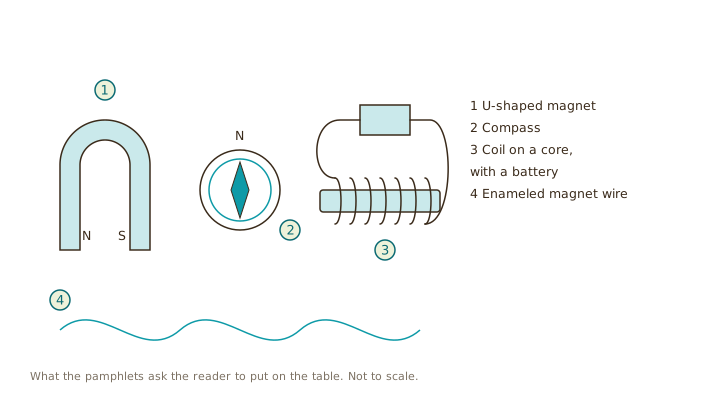
Standard physics describes magnetic fields as produced by electric currents. These can be macroscopic currents in wires or microscopic currents associated with electrons in atomic orbits. Field sources are dipolar, with a north and a south pole. The SI unit of the field is the tesla, and 1 tesla equals 10,000 gauss. The force on a moving charge is F = qvB, with its direction given by the right-hand rule. The HyperPhysics magnetic field page at Georgia State University sets all of this out. Leedskalnin's "north and south pole individual magnets," particles he says circulate in the metal, have no counterpart in this description. On the bench he observed a coil on a magnet, a battery, and a compass needle that moves. The textbook describes the same set of effects. The guides take his claims one at a time.
Who publishes this site
Unconventional Magnets is an editorial project of SEO S.R.L., based in Calimera, Italy. The About page lists the publisher, the author, and the editorial method in full. The domain has existed since 2014; the current project dates from 2026.
FAQ
What does "unconventional magnets" mean? It is the name of the site, taken from Leedskalnin's use of the word "magnets." In Magnetic Current (1945) he writes that the metal itself is not the magnet; the magnet, for him, is a substance circulating inside it. That use is unconventional; the site reads it closely and compares it with the textbook definition.
Did Edward Leedskalnin use magnetism to build Coral Castle? There is no documented evidence that he did. Photographs and eyewitness accounts show pulleys and other simple tools on the site, and his own stock answer was that he understood weight and leverage. A few teenagers later claimed to have seen blocks move by themselves; the claim is recorded, not confirmed.
Where can I read Magnetic Current for free? A scan of the 1945 pamphlet is on the Internet Archive, and our guide links to it. We do not republish the full text. Reprint editions are sold by major booksellers. Our guide to Magnetic Current is meant to be read alongside the scan, section by section.
Does the Perpetual Motion Holder produce electrical power? No. The device described in Magnetism is a U-shaped iron core with two coils and a bar that closes the magnetic circuit. After a battery pulse, the bar stays attached with no power source connected. Nothing runs and no output can be drawn from it. The name is Leedskalnin's; the guide explains what is observed.
Do you sell magnets or kits? No. The site has no store, no prices, and in this version no affiliate links. Parts lists use generic names so you can buy from any hardware or electronics supplier. If affiliate links are added later, the page that carries them will say so. The model is described on the How this site earns page.
Read next: Coral Castle: what is documented, what Ed Leedskalnin claimed
Sources
- Wikipedia, "Edward Leedskalnin" — https://en.wikipedia.org/wiki/Edward_Leedskalnin (checked September 1, 2026)
- Wikipedia, "Coral Castle" — https://en.wikipedia.org/wiki/Coral_Castle (checked September 1, 2026)
- Edward Leedskalnin, Magnetic Current, Rock Gate, Homestead, Florida, 1945 — scan at https://archive.org/details/edleedskalninmagneticcurrent
- Edward Leedskalnin, A Book in Every Home, 1936 — scan at https://archive.org/details/30377259edleedskalninabookineveryhome
- HyperPhysics, Georgia State University, "Magnetic Field" — https://hyperphysics.gsu.edu/hbase/magnetic/magfie.html