Tycho Brahe and Kepler: measurement first, theory second
Tycho Brahe recorded the positions of stars and planets for about two decades with naked-eye instruments accurate to roughly two arcminutes. Johannes Kepler inherited those records in 1601 and, after ten years of work on Mars, derived the three laws of planetary motion (1609, 1619). The measurements came first, and the theory had to fit them. We read Leedskalnin's claims by the same rule.
The hub of this section is Saturn, where the same rule applies to one planet: numbers first, each with a NASA source. The site index is Start here.
What did Tycho Brahe measure, and with what instruments?
Tycho measured the altitude and angular separation of stars and planets with large graduated instruments, and he never used a telescope. Wikipedia describes him as the last major astronomer to work without one (Wikipedia).
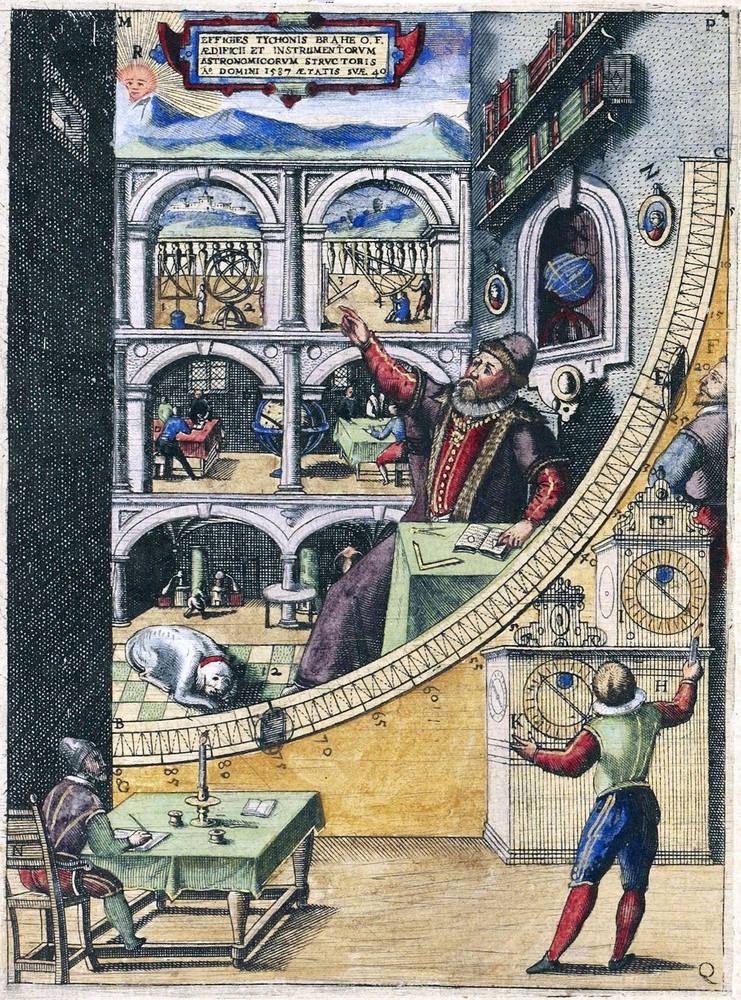
His observatory was Uraniborg, on the island of Hven (today Ven, Sweden), then Danish territory. The cornerstone was laid on August 8, 1576; an underground annex, Stjerneborg, followed in 1584 (Wikipedia, Uraniborg). The main instrument was a mural quadrant: a brass quarter-circle of about 194 cm (6.4 ft) radius fixed to a wall aligned north-south. It gave the altitude of a star as the star crossed the meridian (Figure 1). He also built sextants, armillary spheres, and a steel azimuth quadrant with a six-foot (194 cm) brass arc.
A longer arc holds finer divisions. The median error of star positions in his final catalog was about 1.5 arcminutes, and the mean error in each coordinate about 2 arcminutes. That was roughly five times better than his contemporary Wilhelm of Hesse (Wikipedia). One arcminute is 1/60 of a degree. That precision, repeated for two decades, is the raw material Kepler worked from.
Tychonic system vs. Copernican system: which model did Tycho hold?
Tycho held his own model, published in 1588: the Sun, Moon, and stars circle the Earth, while the other five planets circle the Sun (Wikipedia, Tychonic system). It kept the Earth at rest and still used the Copernican geometry for the planets.
His reasons were observational and physical. He saw no stellar parallax, the shift in star positions that an orbiting Earth should produce over six months. If stars were far enough away to hide that shift, their apparent disks implied implausibly large bodies. And in the physics of his time a heavy body naturally rests: the Earth, he wrote, was too heavy and dense to move so fast (Wikipedia, Tychonic system).
The model was wrong; the data were not. Kepler's laws describe orbits around the Sun, yet they rest on positions measured by a man who rejected a moving Earth. A measurement made carefully enough survives the theory of the person who made it.
What did Kepler do with the Mars data?
Kepler used Tycho's Mars observations to show that the orbit is an ellipse. He reached Prague on February 4, 1600, as Tycho's assistant (Wikipedia). NASA notes that Tycho, who "mistrusted Kepler," assigned him the orbit of Mars, whose motion fit poorly into the older models (NASA).
Tycho died on October 24, 1601. Two days later Kepler was appointed his successor as imperial mathematician to Rudolf II (Wikipedia). He then spent about ten years on Mars; the manuscript of Astronomia nova was complete by September 1607 and printed in 1609 (Wikipedia, Astronomia nova).
The decisive moment was a residual of eight arcminutes. Kepler's best circular model missed Tycho's positions by 8 arcminutes, about four times Tycho's typical error, by our arithmetic, so the model, not the data, had to go. In Astronomia nova (1609) Kepler wrote that "these eight minutes alone will lead us along a path to the reform of the whole of Astronomy" (Wikipedia, Astronomia nova).
Mars's orbit has the highest eccentricity of the planets after Mercury (Wikipedia, Kepler's laws). The gap between a circle and an ellipse was therefore large enough to show in two-arcminute data.
Kepler's three laws, one sentence each
First law (1609). Each planet's orbit is an ellipse with the Sun at one focus; Kepler showed it for Mars in Astronomia nova (NASA; Wikipedia).
Second law (1609; modern form 1621). The line joining a planet and the Sun sweeps out equal areas in equal times, so a planet moves faster when nearer the Sun; Wikipedia notes that Kepler gave the modern form only in the Epitome of 1621 (Wikipedia).
Third law (1619). The square of a planet's orbital period is proportional to the cube of the semi-major axis of its orbit, published in Harmonices Mundi (NASA; Wikipedia).
The laws are descriptive: they say how planets move, not why. Kepler also turned Tycho's records into the Rudolphine Tables, completed in September 1627 (Wikipedia). Saturn's orbit obeys the same three laws; the Saturn hub gives its period from NASA.
What the sources say about Tycho's death
The sources say Tycho Brahe was not poisoned. The 2014 version of this page suggested he was murdered, possibly by Kepler. We looked for a source and found the opposite.
An exhumation in 1901 reported mercury in his remains, and that report fed the poisoning story for a century (Wikipedia). In 2010 a Danish-Czech team exhumed the body again. Jens Vellev (Aarhus University), Kaare Lund Rasmussen (University of Southern Denmark), and Jan Kučera (Nuclear Physics Institute, Prague) analyzed beard hair and bone with three methods: cold vapor atomic absorption spectroscopy, radiochemical neutron activation analysis, and proton microprobe scanning (Aarhus University).
The result: "mercury concentrations were not sufficiently high to have caused his death." Hair levels fell from the high end of normal eight weeks before death to the low end in the last two weeks. Wikipedia summarizes the team's November 2012 report as finding not enough mercury to substantiate murder, and no lethal level of any poison. Modern medical assessment points instead to a burst bladder or a prostate condition leading to urinary retention and uremia (Wikipedia).
We removed the murder paragraph rather than hedge it. A claim with no source does not get a "some say."
Why this matters for the Leedskalnin pages
Tycho and Kepler give us the test we apply to Edward Leedskalnin: is this a repeatable observation, or an assertion? Tycho's positions could be rechecked with a similar quadrant; that is why they outlived his wrong model.
On the Coral Castle hub we sort what is documented about the site from what Leedskalnin claimed about it. On the magnetism page we put standard physics, with sources, beside each of his statements. An experiment with a magnet and wire is an observation to be repeated. A conclusion about the nature of magnetism is his claim, reported with its date and attribution, and nothing more. The Saturn's hexagon page follows the same order: photographs first, explanations decades later.
FAQ
Did Tycho Brahe use a telescope?
No. Wikipedia describes Tycho as the last major astronomer to work without a telescope. He measured angles with large graduated instruments, including a brass mural quadrant of about 194 cm (6.4 ft) radius, sextants, and armillary spheres, reaching a mean error of about 2 arcminutes per coordinate in his star catalog.
When did Tycho Brahe and Kepler meet?
In 1600, in Prague. Kepler arrived on February 4, 1600, to work as Tycho's assistant under the patronage of Emperor Rudolf II. Tycho assigned him the orbit of Mars. Tycho died on October 24, 1601, and Kepler was named his successor as imperial mathematician two days later, according to Wikipedia.
Was Tycho Brahe poisoned with mercury?
No, according to the 2010-2012 analysis by Aarhus University, the University of Southern Denmark, and the Nuclear Physics Institute in Prague. Beard hair and bone tested by three methods showed mercury concentrations too low to have caused his death. Modern medical assessment attributes the death to a bladder or prostate condition.
What are Kepler's three laws in plain words?
Orbits are ellipses with the Sun at one focus; a planet sweeps out equal areas in equal times, so it moves faster when closer to the Sun; and the square of the orbital period is proportional to the cube of the orbit's semi-major axis. The first two appeared in 1609, the third in 1619, per NASA and Wikipedia.
Read next: Saturn: rings, moons, missions, and the hexagon and Numbers and patterns.
Sources
- Wikipedia, "Tycho Brahe" — https://en.wikipedia.org/wiki/Tycho_Brahe (accessed September 1, 2026)
- Wikipedia, "Uraniborg" — https://en.wikipedia.org/wiki/Uraniborg
- Wikipedia, "Tychonic system" — https://en.wikipedia.org/wiki/Tychonic_system
- Wikipedia, "Johannes Kepler" — https://en.wikipedia.org/wiki/Johannes_Kepler
- Wikipedia, "Kepler's laws of planetary motion" — https://en.wikipedia.org/wiki/Kepler%27s_laws_of_planetary_motion
- Wikipedia, "Astronomia nova" — https://en.wikipedia.org/wiki/Astronomia_nova
- NASA Science, "Orbits and Kepler's Laws" — https://science.nasa.gov/resource/orbits-and-keplers-laws/
- Aarhus University, "Mercury poisoning ruled out as cause of Tycho Brahe's death" — https://projekter.au.dk/en/tycho-brahe/pressreleases/mercury-poisoning-ruled-out-as-cause-of-tycho-brahes-death
- Wikimedia Commons, "File:Tycho-Brahe-Mural-Quadrant.jpg" (engraving, Astronomiae instauratae mechanica, 1598; public domain) — https://commons.wikimedia.org/wiki/File:Tycho-Brahe-Mural-Quadrant.jpg