Numbers and patterns: where the number pages start
This is the entry point for the number pages. They cover the Fibonacci sequence and the golden ratio, checked claim by claim against sources. They also separate a number pattern from a physical one, such as the six-sided jet stream at Saturn's north pole. The old "sacred geometry" and "Pythagoras" pages were empty; they now redirect here.
Start here lists every guide on the site in reading order.
What the number pages cover
- Fibonacci and the golden ratio in nature checks the usual examples, from sunflower florets to shells, galaxies and the human body, against sources. What holds up goes in one column; what does not, in the other.
- Saturn's hexagon belongs to the Saturn cluster. The old site placed Saturn next to number patterns; the hexagon is not one (see below).
Fibonacci and the golden ratio: what the guide tests
The guide sorts claims about Fibonacci in living things into supported and unsupported. Leaf and seed arrangement is the documented case: successive sunflower florets sit about 137.5° apart, the golden angle. Shells, spiral galaxies and body proportions are the cases the guide examines one by one, with a source for each verdict.
Saturn's hexagon: a pattern in a fluid
The hexagon is a jet stream at about 77° north latitude, first seen in Voyager images in the early 1980s. Its six sides come from how a wind band flows around the pole, not from a number sequence. No source we have read connects it to φ. The fact sheet has the measurements and how the explanation evolved from 1981 to 2017.
Why the sacred geometry and Pythagoras pages are gone
Both old pages, /sacred-geometry/ and /pitagora/, were empty: no text, no images. We redirected them here rather than write pages we could not source. The two sourced facts behind them follow.
What the sources say
The Pythagorean theorem states that in a right triangle a² + b² = c². The square on the hypotenuse equals the sum of the squares on the other two sides. Historians of Mesopotamian mathematics conclude the rule was in widespread use in the Old Babylonian period, 20th to 16th centuries BC. That is over a thousand years before Pythagoras was born (Wikipedia).
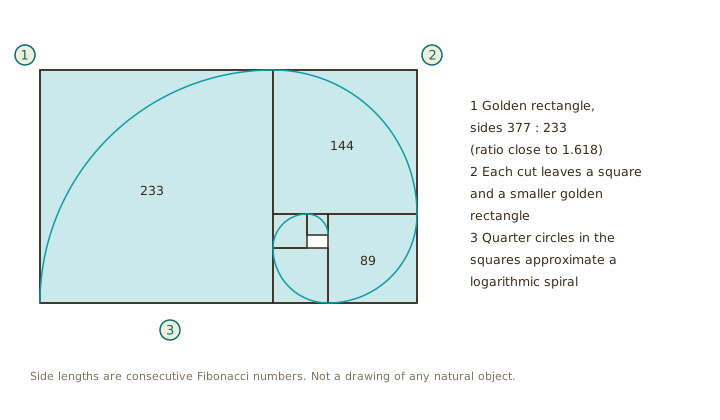
Two quantities are in the golden ratio when their ratio equals the ratio of their sum to the larger of the two (Wikipedia). Solving that condition gives φ = (1 + √5)/2 = 1.618033988749894… (MathWorld). A rectangle in that ratio splits into a square and a smaller rectangle in the same ratio: Figure 1.
FAQ
Is the golden ratio the same thing as the Fibonacci sequence? No. The golden ratio is a single number, φ = (1 + √5)/2. The Fibonacci sequence is a list of integers, each the sum of the two before it. The ratio of consecutive Fibonacci numbers tends to φ, but the sequence never contains φ.
Does the golden ratio appear in Saturn's hexagon? Not in any source we have read. The hexagon is a jet stream at about 77° north on Saturn, imaged by Voyager and Cassini; its shape comes from fluid motion around the pole. A regular hexagon has 120° interior angles and needs no φ to describe it.
Where did the sacred geometry page go? It redirects here. The old page, and the old Pythagoras page, had no text and no images, so there was nothing to rewrite. The one sourced fact behind "sacred geometry," the golden ratio, is defined here and tested against nature in the Fibonacci guide.
Read next: Fibonacci and the golden ratio in nature.
Sources
- Wikipedia, "Golden ratio" — https://en.wikipedia.org/wiki/Golden_ratio
- MathWorld, "Golden Ratio" — https://mathworld.wolfram.com/GoldenRatio.html
- Wikipedia, "Fibonacci sequence" — https://en.wikipedia.org/wiki/Fibonacci_sequence
- Wikipedia, "Golden angle" — https://en.wikipedia.org/wiki/Golden_angle
- Wikipedia, "Pythagorean theorem" — https://en.wikipedia.org/wiki/Pythagorean_theorem
- NASA, "Spring Reveals Saturn's Hexagon Jet Stream" — https://science.nasa.gov/resource/spring-reveals-saturns-hexagon-jet-stream/