The Great Pyramid of Giza: what is documented (dimensions, dates, construction evidence)
The Great Pyramid of Giza was built for the pharaoh Khufu around 2600 BC, stood 481 ft (146.6 m) tall and used about 2.3 million blocks. Quarries, a logbook of stone deliveries, a workers' town and a quarry ramp from Khufu's reign are documented. Claims about power plants, extraterrestrials and "earth energy grids" have no support in the sources. This page separates the two.
This page belongs to the reading-order index of the site. People ask two questions: what the facts are, and how the pyramids were built. Both get mixed with claims that have never been tested. We keep facts and claims apart and give a source for every number.
What is documented about the Great Pyramid of Giza?
Four categories of evidence exist: the monument itself, the quarries, written records and the settlement of the builders. Each has been measured or excavated and published.
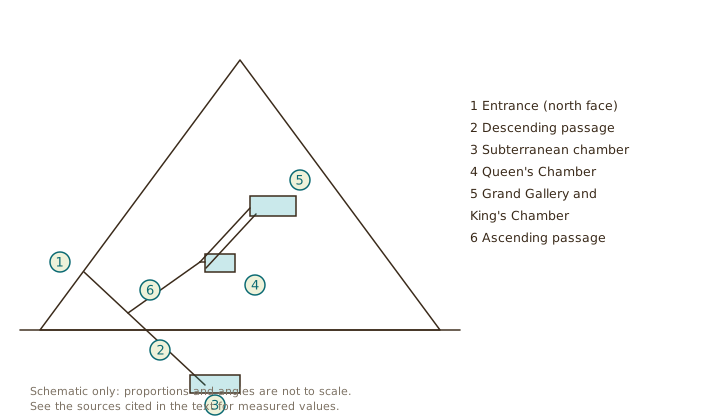
The monument. Flinders Petrie made the first precise survey in 1880–1882. The base is 756 ft (230.33 m) per side, and the faces rise at 51°50'40". Egyptian surveyors expressed that slope as a seked of 5½ palms, a 14:11 ratio (Wikipedia). Three chambers are known: one cut into bedrock below the pyramid, the so-called Queen's Chamber and the King's Chamber above ground. The King's Chamber is reached through the Grand Gallery.
The quarries. The core is local Giza limestone. The white casing came from Tura, across the Nile, which Wikipedia places about 6.2 mi (10 km) southeast of the plateau. The granite beams over the King's Chamber and its relieving chambers came from Aswan, more than 560 mi (900 km) south. Those blocks weigh 25 to 80 metric tons (same source).
The written record. In 2013 a French mission led by Pierre Tallet and Gregory Marouard excavated papyri at Wadi al-Jarf on the Red Sea. One set is the logbook of Merer, an official whose crew of about forty boatmen moved Tura limestone to Giza during Khufu's reign. The pyramid appears under its ancient name, Akhet-Khufu, and Ankhhaf, Khufu's half-brother, oversaw the harbor operation. The Wadi al-Jarf papyri are the oldest known papyri with text (Wikipedia, Diary of Merer).
The builders' town. Since December 1988 Mark Lehner's team (Ancient Egypt Research Associates) has excavated Heit el-Ghurab, south of the Sphinx: more than 7 hectares (17 acres) of galleries, bakeries, silos, warehouses and houses. AERA describes it as the base for the pyramid complexes of Menkaure, Khafre "and probably Khufu" (aeraweb.org). Workers' tombs were found nearby in 1990 (Wikipedia, Giza pyramid complex).
What is claimed, and what the sources answer
Four claims circulate on the query "how were the pyramids built." None of them is supported by the evidence above. We list each with the response of the sources.
- "The pyramid was a power plant." Christopher Dunn's 1998 book proposes that the monument was a machine. Wikipedia lists Dunn among the pyramidology authors who attribute the monument to a lost technology; Egyptologists treat pyramidology as pseudoscience (Wikipedia, Pyramidology).
- "Pyramid power" preserves food and sharpens blades. The idea dates to Antoine Bovis in the 1930s and a 1949 Czechoslovak patent. The reference work is direct: "There is no evidence that pyramid power exists" (Wikipedia, Pyramid power).
- Ancient astronauts. Erich von Däniken (1968) argued the pyramids required a technology the Egyptians lacked. The hypothesis "has received no credible attention in peer-reviewed studies" (Wikipedia, Ancient astronauts).
- Ley lines and "earth energy grids". Alfred Watkins proposed straight tracks between British sites in the 1920s. John Michell reinterpreted them in 1969 as channels of "earth energies," a term never defined in physical units. Statistical studies show that a line drawn almost anywhere clips several sites by chance (Wikipedia, Ley line).
Documented / Claimed / Unknown
| Status | Item | Source |
|---|---|---|
| Documented | Height, base, slope, orientation, three chambers; Khufu's name in the relieving chambers | Wikipedia |
| Documented | Tura limestone delivered by boat under Khufu (Merer's logbook) | Wikipedia, Diary of Merer |
| Documented | A purpose-built town for the builders at Giza | aeraweb.org |
| Documented | A steep quarry ramp from Khufu's time (Hatnub, 2018); water poured before a sledge (tomb of Djehutihotep) | Wikipedia, Wikipedia |
| Claimed | Power plant; extraterrestrial builders | Pyramidology, Ancient astronauts |
| Claimed | Ley lines, "earth energy grid"; golden ratio encoded in the slope | Ley line, Kepler triangle |
| Unknown | Which ramp layout was used at Giza itself (straight, zig-zag, spiral, internal) | Wikipedia |
| Unknown | The exact workforce (estimates from 13,200 average to 50,000) and the exact year of completion | Wikipedia |
What the sources say about moving the blocks
Sledges on wet sand, ramps and levers account for the documented evidence. Nothing in the record requires anything else.
Sledges and water. A painting in the Twelfth Dynasty tomb of Djehutihotep shows 172 men hauling a statue of about 58 metric tons on a sledge. A man at the front pours water on the ground. The decoration was destroyed in 1890 and survives through an earlier photograph (Wikipedia, Djehutihotep). In 2014 a University of Amsterdam team led by Daniel Bonn measured sliding friction on sand. They found that "the correct amount of dampness in the sand halves the pulling force required" (University of Amsterdam, 29 April 2014; paper: Physical Review Letters 112, 175502). Capillary bridges between grains stiffen the sand, so the sledge does not plow into it.
Ramps. Straight, zig-zag and spiral ramps have all been proposed. In 2018 a mission at the Hatnub alabaster quarry found a 4,500-year-old ramp able to move blocks up slopes of 20 percent or more (Wikipedia, construction techniques). It shows the method existed under Khufu; it does not show which layout was used at Giza.
Levers and tools. The same article treats levering as the most tenable complement to ramps. Soft stone was cut with copper chisels, drills and saws; granite was pounded with dolerite and sawn with abrasive.
Workforce. A 1999 construction-management study estimated an average workforce of about 13,200 and a peak of 40,000 (Wikipedia). The excavated town supports organized, fed and housed labor; it does not fix the number.
Why Coral Castle comes up in this context
Edward Leedskalnin built Coral Castle in Florida from 1923 until his death in 1951. Documentaries and blogs cite it alongside Giza as a second case of large stones moved with little equipment. We cover what he built, what he wrote and what is documented about his tools in our Coral Castle guide. The two cases differ in evidence. Giza has quarries, a logbook and a town; Coral Castle has one man, his photographs and his pamphlets. Documentaries such as Zero Point link the two through alignments and grids; we list those claims on the Zero Point page.
One further claim deserves a line. The idea that the pyramid encodes the golden ratio goes back to John Taylor in 1859. Its proportions are explained by the integer ratio 14:11, and there is "no direct evidence in any ancient Egyptian written mathematical source" for phi (Wikipedia, Kepler triangle). We take that up in Fibonacci and the golden ratio in nature.
FAQ
How tall is the Great Pyramid of Giza?
The Great Pyramid was originally 481 ft (146.6 m) tall and now stands at 454 ft (138.5 m) because the casing and capstone are gone. Each base side measures 756 ft (230.33 m). Wikipedia lists these figures, drawn from Petrie's 1880–1882 survey and later measurements.
When was the Great Pyramid built?
Around 2600 BC, during the reign of Khufu, over roughly 26 years. A 2010 radiocarbon study (Ramsey et al.) dates it to 2613–2577 BC; 46 mortar samples taken in 1984 and 1995 gave a wider calibrated window of 2871–2604 BC. The exact year is not known.
Who built the pyramids?
Organized Egyptian work gangs. They left Khufu's name in the relieving chambers, Merer's logbook records boat crews delivering Tura limestone, and AERA has excavated the town that housed and fed the builders at Giza. Nothing in the record points to non-Egyptian builders.
How were the pyramids built?
With quarried blocks moved on sledges, likely over wetted sand, up ramps, and set with levers. A 2014 physics study found that wetting sand halves the pulling force. A steep ramp from Khufu's time was found at Hatnub in 2018. The exact ramp layout at Giza is not documented.
Is the Great Pyramid aligned to true north?
Yes, to within about a tenth of a degree: Wikipedia reports a mean deviation of 3 minutes 38 seconds of arc from true north. How the surveyors achieved this is debated, but it is a documented measurement, not a claim.
Read next: Coral Castle: what is documented and what Ed Leedskalnin claimed.
Sources
- Great Pyramid of Giza, Wikipedia: https://en.wikipedia.org/wiki/Great_Pyramid_of_Giza
- Diary of Merer, Wikipedia: https://en.wikipedia.org/wiki/Diary_of_Merer
- The Lost City of the Pyramid Builders, AERA: https://aeraweb.org/projects/lost-city/
- Giza pyramid complex, Wikipedia: https://en.wikipedia.org/wiki/Giza_pyramid_complex
- Egyptian pyramid construction techniques, Wikipedia: https://en.wikipedia.org/wiki/Egyptian_pyramid_construction_techniques
- Djehutihotep, Wikipedia: https://en.wikipedia.org/wiki/Djehutihotep
- "Ancient Egyptians transported pyramid stones over wet sand", University of Amsterdam, 29 April 2014: https://iop.uva.nl/content/news/2014/00/prl-egyptian-pyramids.html
- Fall et al., "Sliding Friction on Wet and Dry Sand", Physical Review Letters 112, 175502 (2014): https://doi.org/10.1103/PhysRevLett.112.175502
- Kepler triangle, Wikipedia: https://en.wikipedia.org/wiki/Kepler_triangle
- Pyramidology, Wikipedia: https://en.wikipedia.org/wiki/Pyramidology
- Pyramid power, Wikipedia: https://en.wikipedia.org/wiki/Pyramid_power
- Ancient astronauts, Wikipedia: https://en.wikipedia.org/wiki/Ancient_astronauts
- Ley line, Wikipedia: https://en.wikipedia.org/wiki/Ley_line