Saturn's hexagon: fact sheet and how the explanation evolved (1981-2017)
Saturn's hexagon is a six-sided jet stream circling the planet's north pole at about 78° N. It spans roughly 20,000 miles (30,000 km) and reaches at least 47 miles (75 km) below the upper hazes. Its vertices rotate once every 10 h 39 min 23 s. Voyager images from 1980-81 showed it first; Cassini watched it from 2006 to 2017. Researchers model it as a wave on the polar jet.
This page is the detailed companion to our Saturn hub, which covers the planet, its rings, moons, and missions. Here we keep only the hexagon: the measured numbers, and the order in which the explanations arrived.
Fact sheet
| Item | Value | Source |
|---|---|---|
| Latitude | about 78° N (planetographic) | Morales-Juberías et al., ApJL, 2015 |
| Width | about 20,000 miles (30,000 km); a 2007 JPL release gave nearly 15,000 miles (25,000 km) | NASA, Saturn facts; JPL, March 27, 2007 |
| Observed depth | at least 47 miles (75 km) below the upper hazes; "some 100 kilometers (60 miles)" below the cloud tops | NASA Photojournal PIA09186; JPL, 2007 |
| Jet speed | about 200 mph (322 km/h); the papers give about 100 m/s, which is 360 km/h or about 224 mph by our conversion | NASA, Saturn facts; Allison et al., Science, 1990 |
| Rotation period of the pattern | 10 h 39 min 23.01 ± 0.01 s (2008-2014); 3.5 s shorter in Voyager-era data | Sánchez-Lavega et al., GRL, 2014 |
| Discovery | Voyager 1 and 2 flybys, 1980-81; described by D. A. Godfrey in Icarus, 1988 | NASA Photojournal PIA09186; Godfrey, 1988 |
| Cassini observations | infrared images from October 30, 2006; color movie December 10, 2012; last comparisons April 2017; mission ended September 2017 | JPL, 2007; NASA PIA17652; NASA, Cassini timeline |
| Color change | interior went from bluish (2012-13) to golden haze (2016-17), attributed to seasonal photochemical hazes | NASA PIA21049; NASA PIA21611 |
| Largest vortex inside | about 2,200 miles (3,500 km) across | JPL, December 4, 2013 |
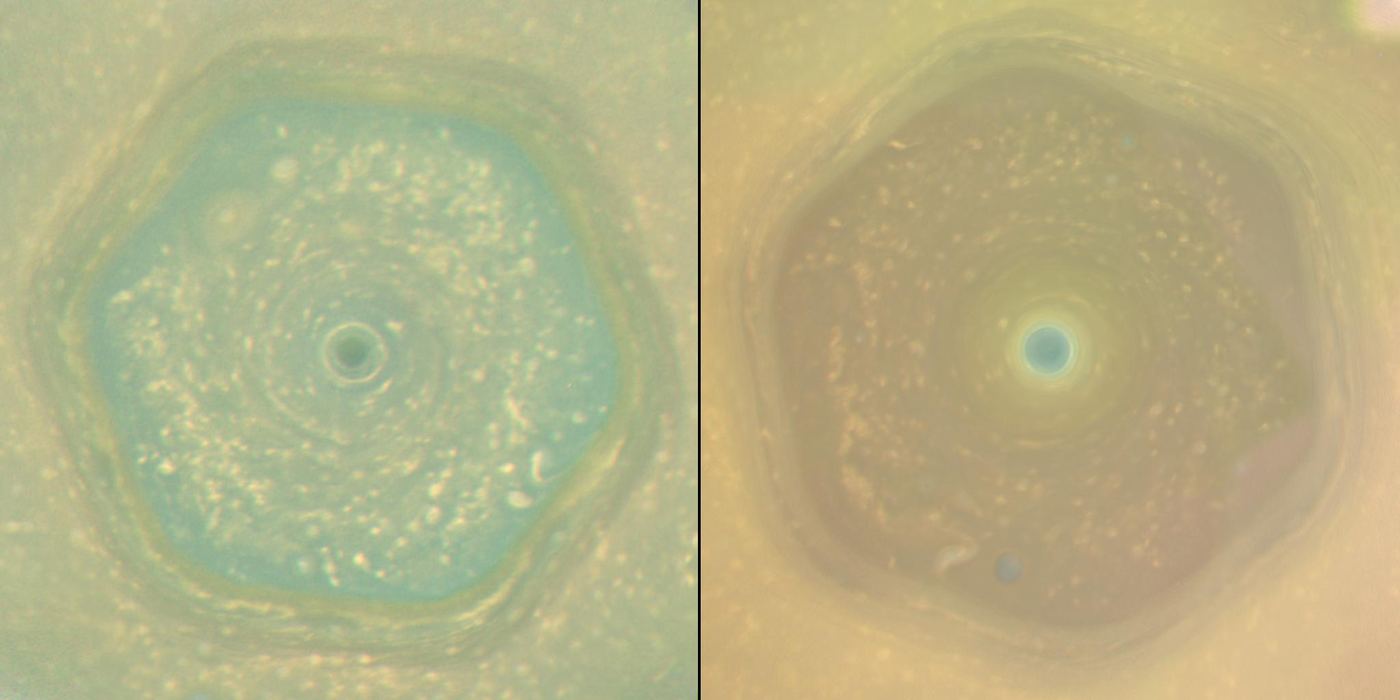
Where is the hexagon and how big is it?
The hexagon sits at about 78° N planetographic latitude and encircles the entire north pole. The 2015 paper by Morales-Juberías and colleagues gives that latitude. It notes that the feature has persisted for more than 30 Earth years, longer than one Saturn year (ApJL 806, L18).
NASA's fact page puts the width at about 20,000 miles (30,000 km), with a rotating storm at the center (NASA). The 2007 JPL release on the first Cassini images gave nearly 15,000 miles (25,000 km); we list both because the pages do not reconcile them (JPL, 2007). A NASA mission page calls the feature twice as wide as Earth (NASA, Cassini).
Two speeds matter, and they differ. The clouds along the sides ride an eastward jet of about 100 m/s, per Allison, Godfrey, and Beebe in 1990 (GISS); NASA quotes 200 mph (322 km/h). The pattern itself barely moves: between 2008 and 2014 its vertices rotated once every 10 h 39 min 23.01 s. The 2015 paper gives a Cassini-era phase speed of −0.036 m/s relative to the System III radio period of 10 h 39 min 24 s. The winds race around the hexagon while the shape stays put.
The feature also has depth. Cassini's infrared spectrometer saw a clearing in the clouds at least 47 miles (75 km) under the upper hazes (PIA09186); the 2007 release says some 100 km (60 miles) below the cloud tops. Inside, the 2012 color movie shows a polar hurricane with an eye about 50 times larger than a typical one on Earth. The largest of the side vortices is about 2,200 miles (3,500 km) across (JPL, 2013).
How the explanation evolved, 1981-2017
The order below is the order of the sources; each entry links to the page we read.
- 1980-81, Voyager. The Voyager 1 and 2 flybys produced the polar mosaics in which the hexagon was first seen (PIA09186; ApJL, 2015). D. A. Godfrey published the description, "A hexagonal feature around Saturn's north pole," in Icarus in 1988 (DOI).
- 1990, a stationary Rossby wave. Allison, Godfrey, and Beebe read the mosaics as a stationary Rossby wave in a sharply peaked 100 m/s jet. In their reading the wave is perturbed by an anticyclonic oval to its south and trapped vertically (Science 247, 1061).
- 2006, Cassini VIMS. From October 30, 2006, Cassini's infrared spectrometer imaged the polar night for 12 days. JPL released the images on March 27, 2007, noting 26 years of persistence. The release added that the team no longer tied the hexagon to Saturn's radio emissions or aurora (JPL, 2007).
- 2010, the laboratory tank. Aguiar, Read, Wordsworth, Salter, and Yamazaki at Oxford produced polygons in a rotating tank whose lid and base spun at different rates. The side count depended on rotation and forcing; they proposed the hexagon is a wavemode of a barotropically unstable jet (Icarus 206, 755). The Planetary Society gives the tank as 10 cm deep and 60 cm wide, with hexagons, heptagons, triangles, and ovals among the results (Planetary Society, 2010).
- 2012-2014, Cassini in sunlight. After the August 2009 equinox the pole was lit again. The December 10, 2012 movie, released December 4, 2013, was the first in color filters (PIA17652). Sánchez-Lavega and colleagues then measured the 2008-2014 rotation period to 0.01 s and showed the jet had survived the polar night unchanged (GRL 41, 1425).
- 2015, the meandering shallow jet. Morales-Juberías and colleagues showed in simulations that instabilities in a shallow jet settle into meanders matching both the shape and the near-zero phase speed. (ApJL 806, L18).
- 2016-2017, color change and end of mission. Cassini recorded the interior turning from blue to gold between 2012 and 2017 (PIA21049; PIA21611). The mission ended with a final plunge into Saturn in September 2017 (NASA timeline).
- 2017, a preprint on the shape. Gerald E. Marsh's arXiv paper, submitted October 30, 2017, argues the feature is an unusual Rossby wave. A spectrum of Rossby waves set by the jet's velocity profile would then explain the rounded corners and the count of six (arXiv:1711.00338).
Our chronology stops at 2017. Later papers exist; we will add them once we have read them.
What the sources say: three explanations
All three treat the hexagon as the shape of the jet stream, not as an object inside it. They differ on what fixes the number six and why the pattern hardly drifts.
A trapped Rossby wave on the polar jet. This is the 1990 reading (Allison et al.). Sánchez-Lavega and colleagues restated it in 2014, calling the hexagon a vertically trapped Rossby wave. Because it survived the seasons unchanged, they propose that hexagon and jet are deep-rooted atmospheric features (GRL, 2014). Marsh's 2017 preprint belongs to the same family.
A polygon selected by jet instability. The Oxford tank produced triangles, hexagons, heptagons, and ovals from one mechanism, the instability of a sheared jet. Rotation and forcing set the side count (Icarus, 2010). On this reading, Saturn's jet sits in the regime where six sides win.
A meandering shallow jet. The 2015 simulations solved the hard part. Earlier models gave six-fold waves with the wrong drift; a shallow jet whose meanders equilibrate matches both morphology and phase speed. The winds at the bottom of the model matter as much as those at cloud level (ApJL, 2015).
None of the sources we read declares the question closed: the 2017 preprint has "enigma" in its title, and the 2015 abstract says some physical aspects are still under investigation. For how measurement precedes theory in astronomy, see our page on Tycho Brahe and Kepler.
What it is not
It is not a storm. Andrew Ingersoll of Caltech said in 2013 that the hexagon is just a current of air: a hurricane on Earth lasts about a week, while this one has been there for decades (JPL, 2013). The storm is at the center; the hexagon is the jet around it.
It is not seasonal. Pattern and jet passed through the polar night of November 1995 to August 2009 with the jet profile essentially unchanged (GRL, 2014; dates from PIA21049). The seasons change the color inside it, not the shape.
It is not tied to Saturn's radio emissions or aurora; by 2007 the Cassini team said the new evidence did not support that link (JPL, 2007).
It is not a made object or a message. A hexagon is what a rotating fluid produces under the right shear, as the 2010 tank experiments showed. None of the NASA, journal, or arXiv sources treats the shape as anything else. Regular numbers in nature are the subject of our numbers pages.
FAQ
What is Saturn's hexagon?
Saturn's hexagon is a six-sided jet stream around the planet's north pole, at about 78° N. NASA gives its width as about 20,000 miles (30,000 km) and its winds as about 200 mph (322 km/h). A rotating storm sits at the center; the hexagon is the current of air around it, per JPL's 2013 release.
How big is Saturn's hexagon compared with Earth?
About twice as wide as Earth, according to NASA's Cassini mission page. The width NASA quotes is about 20,000 miles (30,000 km). The largest of the small vortices inside it spans about 2,200 miles (3,500 km), per the December 2013 JPL release.
Why is it a hexagon and not a circle?
Because the jet is unstable, and the instability settles into a pattern with a fixed number of sides. In the 2010 Oxford tank experiments the side count depended on rotation rate and forcing; the 2015 simulations found that a shallow jet meanders into six lobes with the observed drift. Which of these mechanisms dominates on Saturn is still debated.
Does Saturn's hexagon change with the seasons?
The shape does not; the color does. Sánchez-Lavega and colleagues found the hexagon and its jet unchanged through the polar night that lasted from November 1995 to August 2009. After sunlight returned, Cassini saw the interior turn from bluish to golden between 2012 and 2017, which NASA attributes to photochemical hazes.
When was Saturn's hexagon discovered?
In the Voyager 1 and 2 flyby images of 1980-81. NASA's Photojournal dates the discovery to 1980; D. A. Godfrey published the description in Icarus in 1988. Cassini first imaged it in thermal infrared on October 30, 2006, and in color on December 10, 2012, then followed it until the mission ended in 2017.
Read next: Saturn: rings, moons, missions, and the hexagon at the north pole · Numbers and patterns · Start here
Sources
- NASA Science, Saturn: Facts — https://science.nasa.gov/saturn/facts/ (page dated May 19, 2026; accessed September 1, 2026)
- NASA Science, Cassini: Saturn's Perplexing Hexagon — https://science.nasa.gov/mission/cassini/science/saturn/hexagon-in-motion/
- NASA JPL, "Cassini Images Bizarre Hexagon on Saturn," March 27, 2007 — https://www.jpl.nasa.gov/news/cassini-images-bizarre-hexagon-on-saturn/
- NASA JPL, "NASA's Cassini Spacecraft Obtains Best Views of Saturn Hexagon," December 4, 2013 — https://www.jpl.nasa.gov/news/nasas-cassini-spacecraft-obtains-best-views-of-saturn-hexagon/
- NASA Science Photojournal, "Saturn's Strange Hexagon" (PIA09186) — https://science.nasa.gov/photojournal/saturns-strange-hexagon/
- NASA Science Photojournal, "In Full View: Saturn's Streaming Hexagon" (PIA17652) — https://science.nasa.gov/photojournal/in-full-view-saturns-streaming-hexagon
- NASA Science Photojournal, "Changing Colors in Saturn's North" (PIA21049) — https://science.nasa.gov/photojournal/changing-colors-in-saturns-north
- NASA Science Photojournal, "Saturn's Hexagon as Summer Solstice Approaches" (PIA21611) — https://science.nasa.gov/photojournal/saturns-hexagon-as-summer-solstice-approaches/
- NASA Science, Cassini: Timeline — https://science.nasa.gov/mission/cassini/the-journey/timeline/
- Godfrey, D. A., "A hexagonal feature around Saturn's north pole," Icarus 76, 335-356 (1988) — https://doi.org/10.1016/0019-1035(88)90075-9
- Allison, M., Godfrey, D. A., Beebe, R. F., "A wave dynamical interpretation of Saturn's polar hexagon," Science 247, 1061-1063 (1990) — https://www.giss.nasa.gov/pubs/abs/al04100j.html
- Aguiar, A., Read, P., Wordsworth, R., Salter, T., Yamazaki, Y., "A laboratory model of Saturn's North Polar hexagon," Icarus 206, 755-763 (2010) — https://ora.ox.ac.uk/objects/uuid:d7c14f56-a42e-432a-a28f-6340944fce1c ; https://doi.org/10.1016/j.icarus.2009.10.022
- Lakdawalla, E., "Saturn's hexagon recreated in the laboratory," The Planetary Society, May 4, 2010 — https://www.planetary.org/articles/2471
- Sánchez-Lavega, A., et al., "The long-term steady motion of Saturn's hexagon and the stability of its enclosed jet stream under seasonal changes," Geophysical Research Letters 41, 1425-1431 (2014) — https://arxiv.org/abs/2402.06371
- Morales-Juberías, R., Sayanagi, K. M., Simon, A. A., Fletcher, L. N., Cosentino, R. G., "Meandering Shallow Atmospheric Jet as a Model of Saturn's North-Polar Hexagon," The Astrophysical Journal Letters 806, L18 (2015) — https://iopscience.iop.org/article/10.1088/2041-8205/806/1/L18
- Marsh, G. E., "The Enigma of Saturn's North-Polar Hexagon," arXiv:1711.00338 (2017) — https://arxiv.org/abs/1711.00338