Magnetic Current (1945) by Ed Leedskalnin: a section-by-section reading guide
Magnetic Current is a pamphlet Edward Leedskalnin wrote at Rock Gate, Homestead, Florida, and copyrighted in August 1945. In it he claims that magnetism and electricity are two streams of "individual" north and south pole magnets running against each other. He describes bench experiments with a U-magnet, steel wire, a car battery, and coils. The full scan is free on archive.org.
This page is a reading guide, not a reprint. For each part of the text we give what Leedskalnin wrote, what he asks you to build, and what standard physics says. Our Coral Castle guide covers the man and the site.
- What does Leedskalnin mean by "individual magnets"?
- What equipment does the pamphlet ask you to gather?
- What is "magnetic current," in his words?
- The car battery and the single copper wire
- Electromagnet, transformer, generator: the four-purpose apparatus
- The perpetual motion holder
- The last pages: earth, moon, lightning, and "non-existing electrons"
- Parts list · FAQ
The pamphlet has no chapter headings. The seven sections below follow the order of the text as we read it.
What does Leedskalnin mean by "individual magnets"?
Leedskalnin's core claim is that the metal of a magnet is not the magnet. In Magnetic Current (1945) he writes: "The real magnet is the substance that is circulating in the metal. Each particle in the substance is an individual magnet by itself, and both North and South Pole individual magnets." He describes these particles as smaller than light and always in motion.
The opening pages apply this picture to bar magnets, spheres, and the earth. His evidence is that a sphere magnet can be re-poled by a stronger magnet, so the poles must be something mobile. He offers no measurement.
What standard physics says. A magnetic field is defined by the force it exerts on a moving charge. Its sources are electric currents, "macroscopic currents in wires, or microscopic currents associated with electrons in atomic orbits," and they are "essentially dipolar in nature" (HyperPhysics, magnetic field). No separate north or south particle appears in that description. Domain realignment under a stronger field explains re-poling (HyperPhysics, ferromagnetism); see our magnetism basics page.
What equipment does the pamphlet ask you to gather?
Before any experiment, Leedskalnin lists the kit: "Get a permanent magnet bar four inches long. A U shape magnet that is strong enough to lift from ten to twenty pounds." He adds an Alnico magnet, several feet of hard steel fishing line, and a soft steel welding rod, one-eighth inch (3 mm) thick and three feet (0.9 m) long.
The first task is to make test magnets. Short pieces of fishing line go between the U-magnet's poles, then hang by a thread away from other metal. He magnetizes the welding rod by dragging one pole of the U-magnet along it, never stopping midway. Iron filings show whether a stray pole formed.
Hanging-magnet tests follow, and from the first he concludes that "the magnets can be sent out in straight streams."
What standard physics says. Stroking hard steel with a magnet aligns its domains, and the steel keeps part of that alignment. The retained fraction is the remanence (HyperPhysics, ferromagnetism). A suspended magnetized wire turns to follow the local field, as a compass does. That is ordinary dipole behavior and needs no second kind of particle.
What is "magnetic current," in his words?
Leedskalnin (1945) rejects the idea that electricity is one thing: "Really it is not one current, they are two currents, one current is composed of North Pole individual magnets in concentrated streams and the other is composed of South Pole individual magnets in concentrated streams, and they are running one stream against the other stream in whirling, screwlike fashion, and with high speed." One current alone, he adds, cannot run.
He presents everything that follows, from battery to generator, as a way of concentrating, dividing, and shifting these two streams.
What standard physics says. Electric current is "the rate of charge flow past a given point in an electric circuit," measured in amperes, one coulomb per second. In a metal wire the carriers are electrons; by convention the current direction is the one positive charge would take (HyperPhysics, electric current). One kind of carrier moving one way accounts for the observations.
The car battery and the single copper wire
The longest practical section uses a car battery and a bare copper wire, one-eighth inch thick and eighteen inches (46 cm) long. The reader connects the copper to the positive terminal, lays a short piece of steel across it, and touches the negative terminal "until the copper wire gets hot." The steel comes off magnetized. Leedskalnin (1945) reads it this way: "In a car battery the North Pole magnets run out of positive terminal and South Pole magnets run out of negative terminal."
A steel wire held perpendicular to the copper, he notes, does not magnetize.
What standard physics says. A lead-acid battery gets its voltage from "the reaction of lead and lead oxide with the sulfuric acid electrolyte" (HyperPhysics, lead-acid battery). Around a straight conductor, "the magnetic field lines around a long wire which carries an electric current form concentric circles around the wire" (HyperPhysics, field of a current). A steel piece laid across the wire sits in that circular field and picks up two poles. A piece held radially does not.
Electromagnet, transformer, generator: the four-purpose apparatus
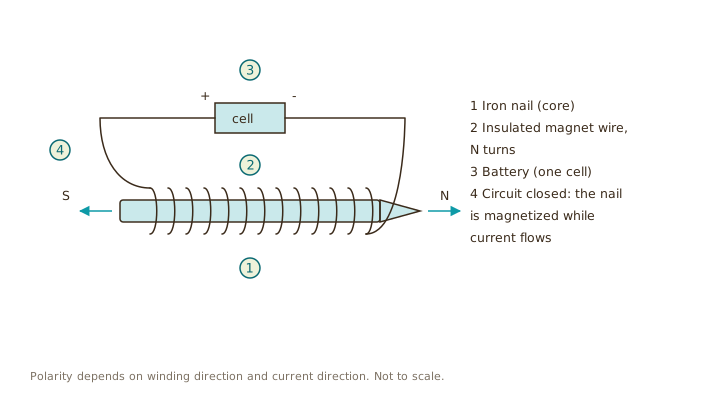
The central build is an iron U-bar, one and a half inches thick with foot-long prongs, carrying two spools wound with "fifteen hundred turns of insulated copper wire, size sixteen." On the battery, it is an electromagnet. For the transformer he adds a small coil of size-18 wire with a three-inch iron core and a 6-to-8-volt bulb. Tapping the battery flashes the bulb, but only with the core in place.
Moving the small coil in and out between the prongs by hand makes the setup a generator. Leedskalnin (1945) is precise on one point: "Put the coil in slowly and take it out slowly, then you will have no light. That will show, to make magnetic currents, the time is important." One pass through a U-magnet gives two flashes, he says, because the current reverses at the middle.
What standard physics says. An electromagnet is an iron-core solenoid: the current's field lines up the domains in the core and multiplies the field "by factors of tens to even thousands" (HyperPhysics, electromagnet). Faraday's law covers the rest: "Any change in the magnetic environment of a coil of wire will cause a voltage (emf) to be 'induced' in the coil." The emf equals the number of turns times the rate of change of flux (HyperPhysics, Faraday's law). A slow pass means a small rate of change and no visible light. Two flashes are the flux rising, then falling.
The perpetual motion holder
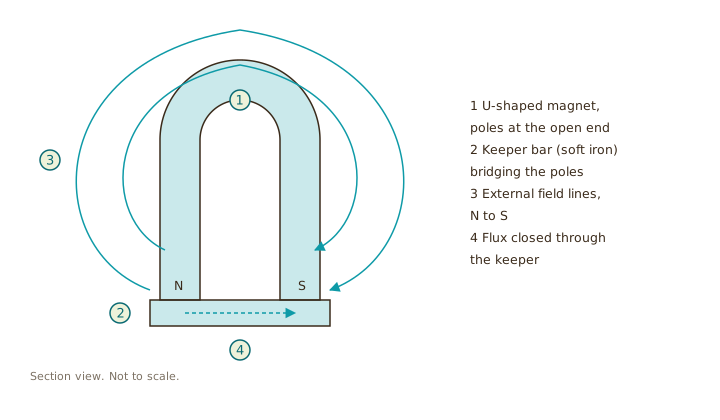
He lays a six-inch iron bar across the prong ends and powers the electromagnet for a moment. Then he disconnects the battery and wires the bulb in its place. Leedskalnin (1945) writes: "I held it in this position for six months, and when I pulled off the six-inch bar I got just as much light out of it as I got in the first time." He adds that "if not disturbed it will last indefinitely."
The six-month figure is his report; we have not replicated it. Our PMH build guide treats the device and the later Magnetism leaflet in full.
What standard physics says. Iron "will tend to stay magnetized to some extent after being subjected to an external magnetic field," a behavior called hysteresis (HyperPhysics, ferromagnetism). A closed iron loop with a keeper holds that residual flux with little loss. Pulling the keeper off collapses the flux quickly, and Faraday's law gives a voltage pulse in the coils (HyperPhysics, Faraday's law). "Perpetual motion" is his name for that flash, not a measured quantity.
The last pages: earth, moon, lightning, and "non-existing electrons"
The final section widens the claim to the cosmos. Leedskalnin (1945) explains his vocabulary: "The reason I call the results of North and South Pole magnet's functions magnetic currents and not electric currents or electricity is the electricity is connected too much with those non-existing electrons." He then attributes the earth's rotation, lightning, the northern lights, radio waves, and the moon's orbit to the same two streams.
These pages contain no experiments. The only number is a claim that the south end of his three-foot magnet was "about a sixteenth of an inch longer" at his latitude. On electrons, the standard account is in section 3 above. We list the astronomical claims for completeness and do not treat them further.
Parts list
Every item below is named in the pamphlet. Sizes are Leedskalnin's; no prices, no suppliers.
| Component | Generic specification (1945 text) | What it is for |
|---|---|---|
| U-shaped permanent magnet | Lifts 10 to 20 lb (4.5 to 9 kg) | Test magnets; field magnet for coil tests |
| Bar magnet | About 4 in (10 cm) | Hanging-magnet tests |
| Alnico magnet | About 3 x 2.5 x 1 in, hole in the middle | Spinning-magnet test |
| Hard steel fishing line | Several feet; stays straight | Short test magnets |
| Soft steel welding rod | 1/8 in (3 mm) thick, 3 ft (0.9 m) long | Long balanced magnet |
| Iron filings | Fine grade, in a paper box | Testing poles and strength |
| Car battery, two leads, four clips | Lead-acid type of the period | Current source |
| Bare copper wire | 1/8 in thick, 18 in (46 cm) long | Single-wire magnetizing |
| Insulated copper wire | Size 16, two 1,500-turn coils; size 18, one 1,500-turn coil | Electromagnet, transformer, generator, PMH |
| Soft iron U-bar and rods | Bar 1.5 in thick, 12 in prongs; rods 1.5 in square, 3 in and 6 in | Core of the apparatus; the 6 in rod is the keeper |
| Small light bulbs | "Radio blue bead," 6 to 8 V | Indicator for induced current |
Magnetic Current — reprint editions and bench parts
The pamphlet is short, and a printed copy is easier to annotate than a scan. The bench parts are ordinary hardware; the only unusual items are a strong U-magnet and enough size-16 magnet wire for two 1,500-turn coils.
Where to find it: any hardware or electronics supplier; reprint editions of the pamphlet are sold by major booksellers.
FAQ
Is Magnetic Current in the public domain?
We have not verified the copyright status of Magnetic Current. The pamphlet carries a 1945 copyright line. The scan is hosted by archive.org without a license field in its metadata, and reprint editions are sold by commercial publishers. We link to the scan and do not republish the text.
Where can I read Magnetic Current as a PDF for free?
The Internet Archive hosts a scan under the identifier edleedskalninmagneticcurrent, uploaded in 2019 to the Community Texts collection. It offers a PDF, an EPUB, and a plain-text file, 51 page images in all.
How long is Magnetic Current?
About 9,200 words by our count of the digitized text. The archive.org scan runs 51 page images; the 2011 Martino Fine Books reprint lists 20 pages.
Does Magnetic Current explain how Leedskalnin moved the stones at Coral Castle?
No. The pamphlet does not mention the stones, the site, or any lifting method. It is entirely about magnets, wire, batteries, and coils, plus a closing section on the earth, moon, and lightning. Our Coral Castle guide separates what is documented from what is claimed.
Do the experiments in Magnetic Current actually work?
The bench procedures are standard demonstrations: magnetizing steel by stroking, a coil flashing a bulb when moved through a magnet, a keeper holding residual flux. Standard physics predicts each result. What does not follow is Leedskalnin's interpretation of two particle streams. We have not replicated the experiments ourselves.
Sources
- Edward Leedskalnin, Magnetic Current, Rock Gate, Homestead, Florida, copyright August 1945. Scan: https://archive.org/details/edleedskalninmagneticcurrent
- Internet Archive item metadata (page count, files, collection): https://archive.org/metadata/edleedskalninmagneticcurrent
- Wikipedia, "Edward Leedskalnin" (dates; bibliography entry for the 1945 printing): https://en.wikipedia.org/wiki/Edward_Leedskalnin
- Coral Castle, official site: https://coralcastle.com/
- Open Library, ISBN 1614271143 (Martino Fine Books, 2011): https://openlibrary.org/isbn/1614271143.json
- HyperPhysics (Georgia State University), Magnetic field: https://hyperphysics.gsu.edu/hbase/magnetic/magfie.html
- HyperPhysics, Ferromagnetism: https://hyperphysics.gsu.edu/hbase/Solids/ferro.html
- HyperPhysics, Electric current: https://hyperphysics.gsu.edu/hbase/electric/elecur.html
- HyperPhysics, Magnetic field of a current: https://hyperphysics.gsu.edu/hbase/magnetic/magcur.html
- HyperPhysics, Electromagnet: https://hyperphysics.gsu.edu/hbase/magnetic/elemag.html
- HyperPhysics, Faraday's law: https://hyperphysics.gsu.edu/hbase/electric/farlaw.html
- HyperPhysics, Lead-acid battery: https://hyperphysics.gsu.edu/hbase/electric/leadacid.html
Read next: Perpetual Motion Holder: how to build one and what it actually does and Magnetism basics: poles, fields, domains, and the U-magnet. Leedskalnin's earlier pamphlet is covered in A Book in Every Home (1936); all guides in reading order are at Start here.