Coral Castle: what is documented and what Ed Leedskalnin claimed
Coral Castle was built by one man, Edward Leedskalnin, between about 1923 and 1951, first in Florida City and then in Homestead, Florida. The tools kept at the site and period photographs show tripod-mounted chain hoists, block and tackle, and homemade levers. Leedskalnin said he understood leverage; separately, he wrote his own theory of magnetism. No record describes the step-by-step handling of any single stone.
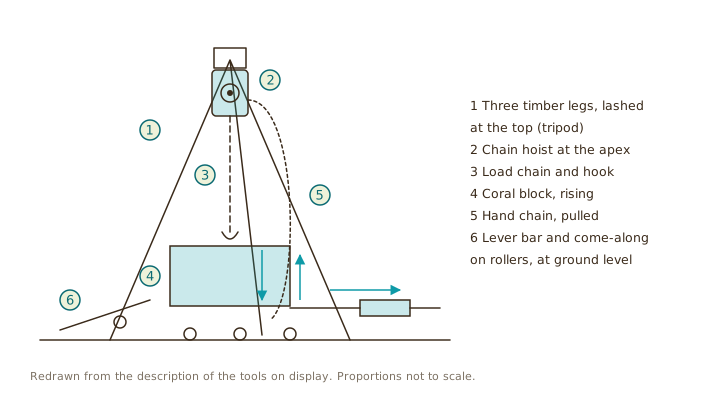
How was Coral Castle built, according to the record?
The record shows simple lifting gear and one man working for about 28 years. Wikipedia states that "photographs and eyewitness accounts evidence that he used pulleys and other simple tools" (source). The official site says he used "tripod-mounted chain falls and basic block and tackle" plus tools made from old car and truck parts (source).
The tools collection at Homestead lists 21 items (source). One is a homemade lever, described as "part of a large come along used to pull large objects." A come-along is a hand-ratcheted winch. These are the objects in Figure 1.
One witness is named. Orval Irwin reportedly saw Leedskalnin quarry stone and raise parts of the wall (source). Beyond that, the site is the evidence: the 9-ton gate, two 25-foot (7.6 m) structures, a sundial, chairs and tables cut from oolitic limestone.
The record lacks a construction log: nobody wrote down how a given block was quarried, rolled, raised, and set. Every later theory sits in that gap. We keep the gap visible, here and in the five pamphlet guides listed in our reading-order index.
Documented, claimed, unknown
Documented: an object, photograph, or dated record exists. Claimed: somebody said it, Leedskalnin included. Unknown: no record either way. Each row has its own source.
| Status | Item | Source |
|---|---|---|
| Documented | Tripod-mounted chain hoists, block and tackle, and simple tools, seen in period photographs and by witnesses; tools on display | coralcastle.com; Wikipedia; tools |
| Documented | 1,100 short tons in all; heaviest stone 30 short tons; average 15 | Wikipedia |
| Documented | Polaris telescope: a 25-foot, 20-ton monolith with a bored hole aligned to a second stone 25 feet away | coralcastle.com, science page |
| Documented | Moved about 10 miles to Homestead with a hired truck and driver | Wikipedia |
| Documented | Five pamphlets, advertised in local newspapers | Wikipedia; archive.org |
| Claimed | Blocks moved "like hydrogen balloons" (attributed to a few teenagers) | Wikipedia |
| Claimed | The site was built with "reverse magnetism or supernatural abilities" (reported by the encyclopedia, not endorsed) | Wikipedia |
| Claimed | His reported answer: he understood "the laws of weight and leverage" and knew how the pyramid builders worked | Wikipedia; coralcastle.com, history |
| Claimed | Matter is held together by "North and South Pole individual magnets" (Leedskalnin's theory, 1945) | Magnetic Current, 1945 |
| Unknown | The exact procedure used to quarry, move, and set each stone | coralcastle.com, science page: "the question remains" |
The magnetism row needs one clarification. Leedskalnin's theory is about what a magnet is and how current runs in a wire. In the copy of Magnetic Current we work from, the words "stone," "pyramid," "leverage," and "gravity" do not appear. Others made the link between his magnetism and his stonework, later.
Timeline, 1887 to 1951
Dates come from Wikipedia and coralcastle.com; where they differ, we give both readings.
| Year | Event | Source |
|---|---|---|
| 1887 | Born January 12 in Latvia (the two sources name different places: a rural parish and Riga) | Wikipedia; coralcastle.com |
| 1912-1920 | Arrives in New York City on April 7, 1912; the 1920 census records him in Reedsport, Oregon | Wikipedia |
| 1923 | Moves to Florida in the winter of 1922-23; buys one acre (209 by 210 feet) in Florida City in February for 10 dollars; construction of "Rock Gate" begins | coralcastle.com; Wikipedia |
| 1920s-1930s | Tours at 10 cents at Florida City; the original sign is on display | Wikipedia; coralcastle.com, exhibits |
| 1935-1936 | Decides to move; buys 10 acres in Homestead by 1936. The move takes about three years | coralcastle.com; Wikipedia |
| 1936 | Publishes A Book in Every Home | archive.org |
| 1945-1946 | Publishes Magnetic Current (copyright August 1945) and Mineral, Vegetable and Animal Life (October 1945); advertises them in the Miami Daily News on February 3, 1946 | archive.org; pamphlet copyright and advertisement lines |
| 1951 | Enters Jackson Memorial Hospital, Miami, November 9; dies December 7 of a kidney infection | Wikipedia |
What Ed said
Three short passages from the pamphlets show how he framed his work.
Magnetic Current (1945) opens with a statement of scope. He calls the text "the result of my two years experiment with magnets at Rock Gate, seventeen miles Southwest from Miami, Florida." He presents it as a report of bench work, not as an account of building.
On what a magnet is, he writes in the same pamphlet: "The real magnet is the substance that is circulating in the metal. Each particle in the substance is an individual magnet by itself, and both North and South Pole individual magnets." This is the core of his theory, and it departs from textbook physics, which we set out in our magnetism basics page.
On current, Magnetic Current (1945) states: "Magnetic current is the same as electric current is a wrong expression. Really it is not one current, they are two currents." Everything else in the pamphlet follows from that sentence. Our section-by-section guide to Magnetic Current walks through each experiment he describes.
On the stones, the only words we have are reported. Wikipedia quotes him as usually answering that he understood "the laws of weight and leverage" (source). The official site tells the same story: asked how, "Ed would tap his forehead and say he knew the laws of weights and leverage" (source).
Coral Castle and magnetism: where the claim comes from
The claim rests on Leedskalnin's pamphlets about magnets and on second-hand stories of floating blocks. Neither connects the two.
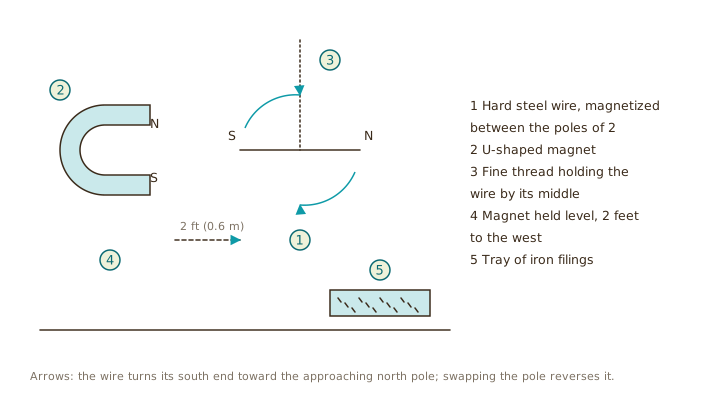
The pamphlets are about magnets, wire, batteries, and a device he called the perpetual motion holder. In Magnetic Current (1945) he asks the reader for three things. A U-shaped magnet "strong enough to lift from ten to twenty pounds" (4.5 to 9 kg), hard steel fishing line, and a soft steel welding rod. The tests use hanging wires and iron filings. Figure 2 reproduces the first of them; our guide to the perpetual motion holder covers the device.
The floating-stone story comes from unnamed teenagers (source). The official site does not repeat it. It says that "the question remains" how he achieved his alignments without powered tools (source).
What standard physics says
Standard mechanics explains lifting heavy stone with light gear by trading force for distance. HyperPhysics states the principle: a simple machine lets you trade "a small force acting through a large distance for a large force acting through a small distance" (source).
For a lever, the ideal mechanical advantage is the ratio of the arms: F_r / F_e = L_e / L_r (HyperPhysics). L_e is the long effort arm and L_r the short resistance arm. A long bar under a block, pivoting on a stone chip near it, raises that edge with a fraction of the block's weight.
For a pulley system, the advantage equals the number of rope segments supporting the load. The UC Santa Cruz demonstration lab shows a four-rope rig: "The weight is now distributed between four ropes. This gives us a mechanical advantage of four," so 25 newtons of pull lift a 100-newton load, at the cost of pulling four times the rope length (source). A chain hoist works on the same principle with gearing added.
Two caveats limit what this settles. First, friction reduces the real advantage. The gain from more sheaves is "offset by both the increased length of rope needed and the friction in the system" (Wikipedia). Second, owning the right tools is not a record of using them on a specific 20- or 30-ton stone. Physics says the documented gear is sufficient in principle; it does not reconstruct the job.
Parts list for the two figures
Generic descriptions only. No prices, no vendors.
| Part | Generic characteristic | Role in the figure |
|---|---|---|
| ① Tripod legs (Fig. 1) | Three timber poles, lashed at the apex | Support the hoist over the load |
| ② Chain hoist (Fig. 1) | Hand-operated geared hoist | Raises the block slowly |
| ③ Load chain and hook (Fig. 1) | Steel chain rated for the load | Carries the stone |
| ⑤ Hand chain (Fig. 1) | Endless loop driving the gearing | Takes the operator's pull |
| ⑥ Lever bar and come-along (Fig. 1) | Long steel bar; hand-ratcheted cable winch | Tips the block onto rollers; drags it |
| ① Steel wire (Fig. 2) | Hard steel fishing line, cut to the U-magnet gap | The hanging test magnet |
| ② U-shaped magnet (Fig. 2) | Horseshoe magnet lifting 10 to 20 lb, per the pamphlet | Magnetizes the wire; moving pole in the test |
| ③ Thread (Fig. 2) | Fine thread or, per the pamphlet, spider silk | Lets the wire swing |
| ⑤ Iron filings (Fig. 2) | Iron powder in a shallow tray | Shows where poles sit |
Visiting Coral Castle
Coral Castle is at 28655 S. Dixie Highway, Homestead, FL 33033, phone (305) 248-6345 (source). We checked the official site on September 1, 2026. Its footer prints two schedules without saying which days each applies to: "Open daily from 9AM–8 PM. Last tour begins at 7:00PM. Gates close at 7:30PM." and "Open daily from 9AM–7 PM. Last tour begins at 6:00PM. Gates close at 6:30PM." Call before a late-afternoon visit.
Admission is charged and tickets are sold on site. The official page states that each ticket includes a 30-minute documentary and a guided tour, and that the grounds are wheelchair accessible (source). Rates are on that page; we re-check the hours given here every six months.
Reading Leedskalnin: the five pamphlets
Each pamphlet has a section-by-section guide here, with the experiments redrawn.
- Magnetic Current (1945): the wire, battery, and U-shaped magnet experiments.
- A Book in Every Home (1936): "Ed's Sweet Sixteen" and his views on education and politics.
- Magnetism and the perpetual motion holder: the device, its build, and remanence.
- Mineral, Vegetable and Animal Life (1945): on "magnets" and living matter.
- Magnetic Base: his appeal to researchers and what he asked them to test.
Read next: Magnetic Current (1945), section by section.
FAQ
How was Coral Castle built?
By Edward Leedskalnin alone, over about 28 years. The official site and the photographs cited by Wikipedia show tripod-mounted chain hoists, block and tackle, and levers made from car and truck parts. The exact handling of each stone was never recorded. Both sources agree on the tools; neither describes the full procedure.
Did Ed Leedskalnin use magnetism to move the stones?
No document says so. His 1945 pamphlet Magnetic Current describes bench experiments with magnets and wire and never mentions stone, leverage, or gravity. The floating-stone account comes from unnamed teenagers, as Wikipedia notes. When asked directly, he reportedly answered that he understood the laws of weight and leverage.
How much does Coral Castle weigh?
About 1,100 short tons (roughly 1,000 metric tons) of oolitic limestone, a figure given by both Wikipedia and the official site. Wikipedia puts the heaviest stone at 30 short tons and the average at 15. The official site describes the telescope monolith as a 25-foot, 20-ton stone.
Who was Edward Leedskalnin?
A Latvian immigrant born January 12, 1887, who arrived in New York in 1912 and moved to Florida in the winter of 1922-1923. He built Coral Castle from about 1923 until his death on December 7, 1951. He published five pamphlets, mostly on his own theory of magnetism, and sold them by mail.
Can you visit Coral Castle today?
Yes. It operates as a museum at 28655 S. Dixie Highway, Homestead, FL 33033, phone (305) 248-6345. The official site lists opening from 9 AM daily with the last tour in the early evening. Two closing times are printed without a day label, so call ahead. Tickets are sold on site.
Reprint editions of Leedskalnin's pamphlets
The five pamphlets are short and still reprinted, as one paperback or as separate booklets. A printed copy is easier to annotate than the scan while you follow the guides. Where to find it: reprint editions of the pamphlets are sold by major booksellers; the scans are free on archive.org.
Sources
- Wikipedia, "Coral Castle": https://en.wikipedia.org/wiki/Coral_Castle
- Wikipedia, "Edward Leedskalnin": https://en.wikipedia.org/wiki/Edward_Leedskalnin
- coralcastle.com, "About Edward Leedskalnin": https://coralcastle.com/about-edward-leedskalnin/
- coralcastle.com, history page: https://coralcastle.com/the-secrets-of-coral-castle/
- coralcastle.com, "The Science of the Castle": https://coralcastle.com/the-science-of-the-castle/
- coralcastle.com, tools collection: https://coralcastle.com/collection-pages/collections/tools/
- coralcastle.com, exhibits: https://coralcastle.com/exhibits/
- coralcastle.com, "Plan Your Visit" (checked September 1, 2026): https://coralcastle.com/visit/
- Edward Leedskalnin, Magnetic Current (1945), scan: https://archive.org/details/ed-leedskalnin-magnetic-current-1945
- Edward Leedskalnin, A Book in Every Home (1936), scan: https://archive.org/details/30377259edleedskalninabookineveryhome
- HyperPhysics (GSU), "Lever": https://hyperphysics.gsu.edu/hbase/Mechanics/lever.html
- HyperPhysics (GSU), "Simple Machines": https://hyperphysics.gsu.edu/hbase/Mechanics/simmac.html
- UCSC Physics Demonstration Room, "Pulley Mechanical Advantage": https://ucscphysicsdemo.sites.ucsc.edu/physics-5a6a/pulley-mechanical-advantage/
- Wikipedia, "Block and tackle": https://en.wikipedia.org/wiki/Block_and_tackle