Fibonacci and the golden ratio in nature: what holds up and what does not
The Fibonacci sequence and the golden ratio show up reliably in one place: the arrangement of leaves, florets, seeds and scales on plants. Sunflower heads, pine cones and pineapples usually carry Fibonacci numbers of spirals, and successive florets sit about 137.5° apart. The nautilus shell, spiral galaxies, DNA, the human body, the Parthenon and the Great Pyramid do not pass the same test.
This page belongs to the Numbers and patterns section, which defines φ and explains why the old sacred-geometry pages are gone. The site index is at Start here. Here we take the examples that circulate online one by one and keep only what a published measurement supports.
What the sequence and the ratio are
The Fibonacci sequence is a list of whole numbers in which each term is the sum of the two before it. Leonardo of Pisa presented it in Liber Abaci (1202); Indian scholars of Sanskrit prosody had described the same numbers centuries earlier (Wikipedia). The golden ratio is a single number, φ = (1 + √5) / 2 = 1.618033988749894… (Wikipedia).
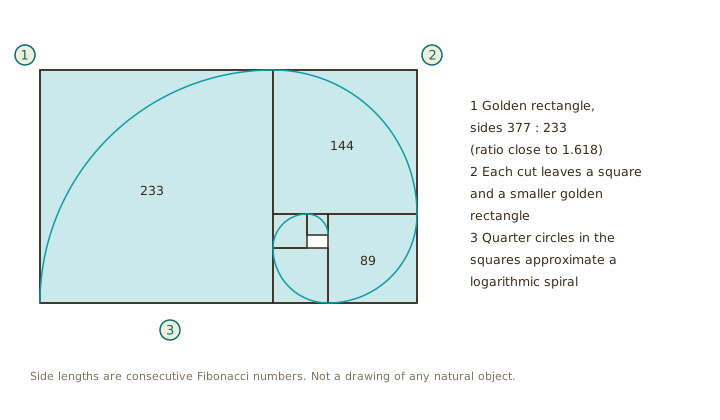
The two are linked by a limit. Divide any Fibonacci term by the one before it and the result approaches φ; 987 / 610 already gives 1.6180327. Kepler noticed this in 1611: "as 5 is to 8 so is 8 to 13, practically." Figure 1 shows the geometric version. A rectangle with sides 377 : 233 splits into a square and a smaller rectangle of the same shape, without end.
Supported by evidence: leaves, seed heads and cones
The one well-documented case is phyllotaxis, the arrangement of leaves, florets and scales around a stem or a head. In sunflowers, pineapples and pine cones, the spirals run in two families, clockwise and counterclockwise. Their counts are usually adjacent Fibonacci numbers, per Wikipedia. Successive florets on a sunflower head are separated by the golden angle, 360° / φ² ≈ 137.5° (Wikipedia, Golden angle).
The best modern count comes from a citizen-science project published in Royal Society Open Science in 2016. Swinton, Ochu and the MSI Turing's Sunflower Consortium collected 657 sunflower heads. The most reliable subset held 768 spiral counts: 565 were Fibonacci numbers, and 67 more showed Fibonacci structure of a predefined type. The remaining counts, roughly one in five, had no Fibonacci structure. The paper also cites earlier surveys that found Fibonacci counts 82 percent (Schoute) and 95 percent (Weise) of the time (Swinton et al. 2016). Roger Jean's Phyllotaxis (Cambridge University Press, 1994) remains the standard reference on the older literature.
So the correct statement is statistical. Most sunflower heads carry Fibonacci spiral counts, and a minority do not. The pattern is a strong tendency of a growth process, not a law.
Petal counts deserve more caution. Field daisies "most often" have a Fibonacci number of petals, per Wikipedia. But the mustard family, Brassicaceae, has four petals in every flower and more than 4,300 species (Wikipedia). Four is not a Fibonacci number. Petal lists that show only lilies, buttercups and daisies are selecting the hits.
Not supported: shells, galaxies, DNA, bodies and buildings
The nautilus shell. Clement Falbo of Sonoma State University measured nautilus shells at the California Academy of Sciences in 1999. The spirals fit rectangles with side ratios of about 1.33, ranging from 1.24 to 1.43. He judged it "highly unlikely" that any nautilus comes within 2 percent of φ (Peterson 2020, reporting Falbo 2005; Falbo 2005). In 2018, Christopher Bartlett measured 80 shells in the Smithsonian collection and found a genus mean of 1.310 (Bartlett 2018). The shell is a logarithmic spiral, and that is the source of the confusion. A logarithmic spiral can have any growth rate; only one, with a pitch angle of about 17.03°, is the golden spiral (Wikipedia, Golden spiral).
Spiral galaxies. The same page notes that it is "sometimes erroneously stated" that galaxies widen as a golden spiral. Their arms are not even fixed logarithmic spirals: the pitch angle changes with distance from the center. A golden spiral drawn over a galaxy photo is an overlay, not a measurement.
DNA. The claim is that one turn of the double helix measures 34 Å long by 21 Å wide, and 34 / 21 = 1.619. The measured B-DNA values are a pitch of 33.2 Å, or 34 Å per 10 base pairs, and a diameter of 20 Å. The same article gives 23.7 Å for the width (Wikipedia). We divided the pairs ourselves: 33.2 / 20 = 1.66 and 34 / 23.7 = 1.43. The "golden" result appears only if you round one number down and the other up.
The human body. The idea goes back to Adolf Zeising, who in 1854 turned a real observation about phyllotaxis into a universal law. For finger bones, the stock example, there is "a large variation in the real measures," and the ratios differ significantly from φ (Wikipedia, Golden ratio). Body-ratio claims survive by averaging many people and choosing which landmarks to divide.
The Parthenon. Keith Devlin's summary is that the assertion "is not supported by actual measurements." A survey of 15 temples, 18 monumental tombs, 8 sarcophagi and 58 grave stelae found the golden ratio "totally absent" from classical Greek architecture. The same Wikipedia section reports that survey. Golden rectangles drawn on the facade start and end at chosen points.
The Great Pyramid. The "golden pyramid" idea began with John Taylor in 1859 and rests on a misreading of Herodotus. A right triangle with sides 11 and 14 explains the proportions. Corinna Rossi (2004) found "no direct evidence in any ancient Egyptian written mathematical source" of the golden section (Wikipedia, Kepler triangle). What is documented about Giza is on our Great Pyramid page.
George Markowsky reviewed this family of claims in 1992. The mathematics of φ is usually stated correctly, he wrote. But "much of what is presented with respect to the golden ratio in art, architecture, literature, and aesthetics is false or seriously misleading" (Markowsky 1992).
Claim by claim: verdict and source
| Claim | Verdict | Source |
|---|---|---|
| Sunflower heads show Fibonacci numbers of spirals | Supported as a strong tendency: 565 of 768 counts, plus 67 with Fibonacci-type structure | Swinton et al. 2016 |
| Pine cones and pineapples show Fibonacci spiral counts | Supported | Wikipedia, Phyllotaxis |
| Successive leaves or florets sit 137.5° apart | Supported; the angle is 360° / φ² | Wikipedia, Golden angle |
| Flowers have a Fibonacci number of petals | Partly: daisies most often do; the mustard family has four | Wikipedia, Fibonacci sequence; Brassicaceae |
| The nautilus shell is a golden spiral | Not supported: ratios 1.24–1.43 (1999); mean 1.310 over 80 shells (2018) | Falbo 2005; Bartlett 2018 |
| Spiral galaxies are golden spirals | Not supported: pitch angle varies with radius | Wikipedia, Golden spiral |
| DNA measures 34 Å by 21 Å per turn | Not supported: measured pairs give 1.43 to 1.66 | Wikipedia, Nucleic acid double helix |
| The human body is built on φ | Not supported: large variation, ratios differ from φ | Wikipedia, Golden ratio |
| The Parthenon fits a golden rectangle | Not supported by measurement; absent from a survey of 99 Greek monuments | Wikipedia, Golden ratio |
| The Great Pyramid encodes φ | Not supported: 1859 origin; 11 : 14 triangle; no Egyptian source | Wikipedia, Kepler triangle; our Giza page |
Why the pattern appears in plants
Plants do not count. The Fibonacci numbers come out of a placement rule at the growing tip. In 1868 Wilhelm Hofmeister proposed that each new leaf primordium forms in the least crowded spot on the shoot meristem (Wikipedia, Phyllotaxis). Modern work identifies the plant hormone auxin as the signal through which existing primordia repel new ones.
The decisive test was a physics experiment. In 1992 Stéphane Douady and Yves Couder published a model in Physical Review Letters. In it, repelling elements are added one at a time (Douady & Couder 1992). Their 1996 paper describes the setup: a dish of silicone oil in a vertical magnetic field, onto which drops of ferrofluid fall at regular intervals. Each drop is polarized, drifts outward and repels the drops already there. With one control parameter, the growth rate, the angle between successive drops converged to 137.5° (137.47° measured). The pattern showed 13 and 21 spirals, both Fibonacci numbers (Douady & Couder 1996).
The magnets in that experiment are a modeling convenience; nothing in a plant is magnetic. The result is that "each new element goes where there is the most room" produces the golden angle on its own. That angle in turn gives the densest packing of florets on the head (Wikipedia, Golden angle). Fibonacci spirals are what you see when you look at that packing.
We give the same kind of explanation for the six-sided jet stream on the Saturn's hexagon page. There too, a regular shape comes from a physical process, with no number sequence behind it.
FAQ
Is the nautilus shell a golden spiral?
No. Measured nautilus shells fit rectangles with side ratios of about 1.24 to 1.43. A 2018 study of 80 Smithsonian shells found a mean of 1.310, not 1.618. The shell is a logarithmic spiral, and logarithmic spirals come in every growth rate. Only one of them is golden.
Do all flowers have a Fibonacci number of petals?
No. Field daisies most often do, and many composite flowers follow the same tendency. The mustard family, with more than 4,300 species, has four petals in every flower, and four is not a Fibonacci number. Petal lists that support the claim leave those families out.
Why is the golden angle 137.5 degrees?
Because 360° divided by φ² equals 137.5078°. If each new leaf or floret appears in the least crowded spot on the growing tip, the angle between successive elements settles at that value. Douady and Couder reproduced the convergence in 1992 with repelling drops of ferrofluid in a magnetic field.
Is the golden ratio in the human body or in DNA?
Not in any measurement we have found. Finger-bone ratios vary widely and differ from φ. For DNA, the "34 by 21" figures are rounded. The measured B-DNA pitch of 33.2 Å and diameter of 20 Å give 1.66, and other measured pairs give 1.43. The idea dates to Zeising in 1854.
Does the Great Pyramid encode the golden ratio?
No source supports it. The claim began with John Taylor in 1859, from a misreading of Herodotus. The pyramid's slope is explained by an 11 : 14 right triangle, and no ancient Egyptian mathematical text contains a golden-section construction. The documented dimensions and construction evidence are on our Great Pyramid page.
Read next: Numbers and patterns, the hub of this section, and Saturn's hexagon, a regular shape made by a fluid.
Sources
- Wikipedia, "Fibonacci sequence" — https://en.wikipedia.org/wiki/Fibonacci_sequence (accessed September 1, 2026)
- Wikipedia, "Golden ratio" (incl. "Disputed observations") — https://en.wikipedia.org/wiki/Golden_ratio
- Wikipedia, "Golden angle" — https://en.wikipedia.org/wiki/Golden_angle
- Wikipedia, "Phyllotaxis" — https://en.wikipedia.org/wiki/Phyllotaxis
- Wikipedia, "Golden spiral" — https://en.wikipedia.org/wiki/Golden_spiral
- Wikipedia, "Kepler triangle" — https://en.wikipedia.org/wiki/Kepler_triangle
- Wikipedia, "Nucleic acid double helix" — https://en.wikipedia.org/wiki/Nucleic_acid_double_helix
- Wikipedia, "Brassicaceae" — https://en.wikipedia.org/wiki/Brassicaceae
- Swinton J., Ochu E., The MSI Turing's Sunflower Consortium, "Novel Fibonacci and non-Fibonacci structure in the sunflower: results of a citizen science experiment," Royal Society Open Science 3:160091 (2016), doi:10.1098/rsos.160091 — https://pmc.ncbi.nlm.nih.gov/articles/PMC4892450/ ; https://royalsocietypublishing.org/rsos/article/3/5/160091/36562/Novel-Fibonacci-and-non-Fibonacci-structure-in-the
- Douady S., Couder Y., "Phyllotaxis as a physical self-organized growth process," Physical Review Letters 68(13):2098–2101 (1992) — https://doi.org/10.1103/PhysRevLett.68.2098
- Douady S., Couder Y., "Phyllotaxis as a Dynamical Self Organizing Process, Part I," Journal of Theoretical Biology 178:255–274 (1996) — https://pdodds.w3.uvm.edu/files/papers/others/1996/douady1996a.pdf
- Jean R. V., Phyllotaxis: A Systemic Study in Plant Morphogenesis, Cambridge University Press (1994) — https://www.cambridge.org/9780521404822
- Falbo C., "The Golden Ratio—A Contrary Viewpoint," College Mathematics Journal 36(2):123–134 (2005) — https://eric.ed.gov/?id=EJ938137 ; https://www.tandfonline.com/doi/abs/10.1080/07468342.2005.11922119
- Peterson I., "Sea Shell Spirals," The Mathematical Tourist, June 30, 2020 (reports Falbo's 1999 measurements) — http://mathtourist.blogspot.com/2020/06/
- Bartlett C., "Nautilus Spirals and the Meta-Golden Ratio Chi," Nexus Network Journal (2018), doi:10.1007/s00004-018-0419-3 — https://doi.org/10.1007/s00004-018-0419-3 ; summary: https://wp.towson.edu/cofacblog/2019/01/03/nautilus-spirals-and-the-meta-golden-ratio-chi/
- Markowsky G., "Misconceptions about the Golden Ratio," College Mathematics Journal 23(1):2–19 (1992) — https://eric.ed.gov/?id=EJ445071 ; https://www.tandfonline.com/doi/abs/10.1080/07468342.1992.11973428