Saturn: rings, moons, missions, and the hexagon at the north pole
Saturn is the sixth planet from the Sun and the second-largest in the solar system. It orbits at an average distance of 886 million miles (1.4 billion km). It spins once every 10.7 hours and completes one orbit in 29.4 Earth years. NASA counts 293 confirmed moons as of August 2026. The rings are chunks of ice and rock, and a six-sided jet stream circles the north pole.
This page is the hub of our Saturn section. The detailed fact sheet on the six-sided jet stream lives at Saturn's hexagon; the wider index of the site starts at Start here.
How far away and how big is Saturn?
Saturn orbits the Sun at an average distance of 886 million miles (1.4 billion km), or 9.5 astronomical units. One astronomical unit is the average Earth-Sun distance, so Saturn sits about nine and a half times farther out than we do. Sunlight needs 80 minutes to cover that distance, according to NASA's Saturn fact page.
The planet is wide but light for its size. NASA gives an equatorial diameter of about 74,897 miles (120,500 km), nine times Earth's. The radius is therefore about 37,450 miles (60,250 km); we derived that figure by halving NASA's diameter. The body is mostly hydrogen and helium, and its average density is lower than that of water. NASA phrases it plainly: Saturn is the only planet in the solar system with an average density below water's.
Two clocks run at very different speeds. A rotation takes 10.7 hours, so a Saturn day is less than half an Earth day. An orbit takes 29.4 Earth years, or 10,756 Earth days. The spin axis is tilted 26.73 degrees to the orbit. Saturn therefore has seasons, as Earth does.
One number belongs on a site about magnets. NASA lists Saturn's magnetic field as 578 times as strong as Earth's. That figure is a useful reminder of scale. A planetary field and the bench magnets on the Coral Castle pages are described on separate pages; for the bench, start at Magnetism basics.
What are Saturn's rings made of?
The rings are made of ice and rock. NASA describes them as billions of small chunks of ice and rock coated with other material, mostly dust. Particle sizes run from dust-sized icy grains up to pieces as big as a house, per the NASA fact page.
Their proportions are extreme. The ring system extends up to 175,000 miles (282,000 km) from the planet, yet its vertical height is typically about 30 feet (10 m).
The rings are not one continuous sheet. The most visible break is the Cassini Division, a gap 2,920 miles (4,700 km) wide, per NASA. It separates the two brightest rings. Both the gap and the spacecraft are named after Giovanni Domenico Cassini, who found the gap in 1675 (Wikipedia, Cassini Division).
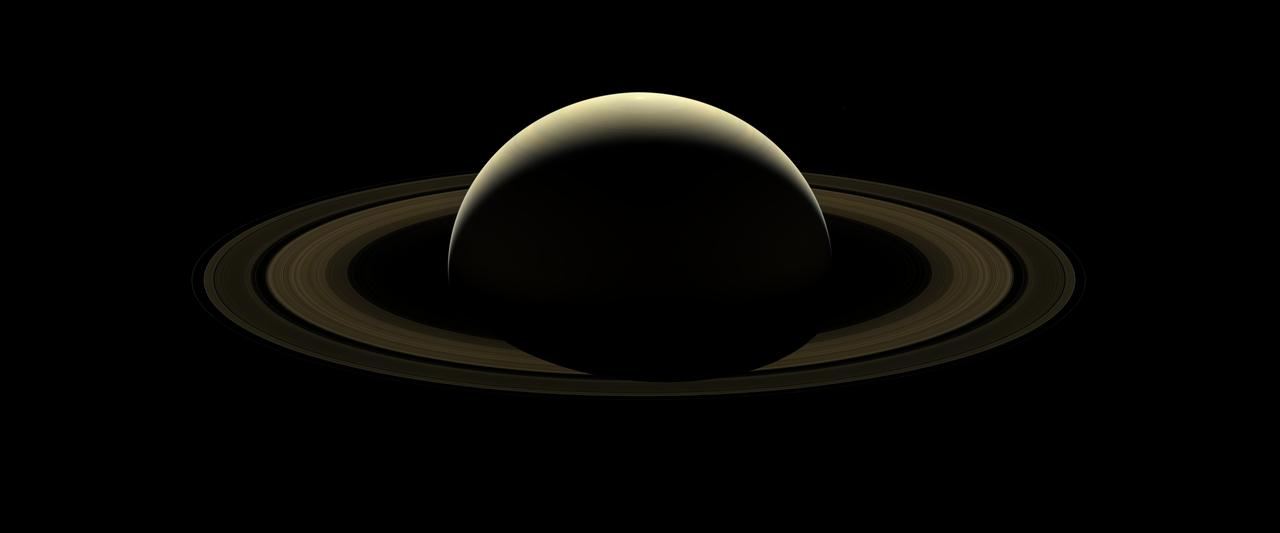
Figure 1 above shows the rings in natural color as Cassini saw them from above the ring plane in 2017. The dark band inside the bright rings is the Cassini Division.
Which moons matter most: Titan and Enceladus
Saturn has 293 confirmed moons as of August 2026, according to NASA's Saturn moons page. That number changes often. NASA's separate fact page still gives 274 as of March 2025, so any count should carry its date, as ours does. The moons range from Titan, which NASA notes is larger than the planet Mercury, down to bodies far smaller.
Titan is the only moon in the solar system known to have a substantial atmosphere, per NASA's Titan page. It has clouds, rain, rivers, lakes, and seas, but they hold liquid hydrocarbons such as methane and ethane rather than water. NASA states that Titan is the only place besides Earth known to have liquids on its surface. The Huygens probe, built by the European Space Agency, landed there on January 14, 2005 (see the missions section).
Enceladus is small, about 310 miles (500 km) across, and has the most reflective surface in the solar system, according to NASA's Enceladus page. In 2005, Cassini found icy particles and gas erupting from warm fractures near the south pole at roughly 800 miles per hour. Scientists informally call those fractures the tiger stripes. Gravity measurements and the moon's slight wobble later showed that a global ocean under the ice shell feeds the jets.
Which spacecraft have visited Saturn?
Four spacecraft have visited Saturn: Pioneer 11, Voyager 1, Voyager 2, and Cassini-Huygens. Three were flybys lasting days; one stayed in orbit for more than 13 years. All dates below are from NASA mission pages.
| Mission | Saturn encounter | Closest approach | Source |
|---|---|---|---|
| Pioneer 11 | September 1, 1979 (flyby) | about 13,000 miles (20,900 km) | NASA, Pioneer 11 |
| Voyager 1 | November 12, 1980 (flyby) | about 78,000 miles (126,000 km) | NASA, Voyager 1 |
| Voyager 2 | August 26, 1981 (flyby) | about 63,000 miles (101,000 km) | NASA, Voyager 2 |
| Cassini-Huygens | in orbit July 1, 2004 to September 15, 2017 | orbiter; final plunge into the atmosphere | NASA, Cassini timeline |
Pioneer 11, launched April 6, 1973, was the first spacecraft to fly past Saturn. It passed about 13,000 miles (20,900 km) from the cloud tops on September 1, 1979.
Voyager 1, launched September 5, 1977, made its closest approach on November 12, 1980. Its images of Titan showed a thick atmosphere that blocked any view of the surface. The same flyby returned the first images of the polar hexagon.
Voyager 2, launched August 20, 1977, passed Saturn on August 26, 1981, at about 63,000 miles (101,000 km), then continued to Uranus and Neptune.
Cassini-Huygens was a joint project of NASA, the European Space Agency, and the Italian Space Agency, per JPL's mission page. It launched on October 15, 1997, and entered orbit on July 1, 2004 UTC (June 30 in California, the date NASA sometimes uses). The Huygens probe landed on Titan on January 14, 2005. After more than 13 years in orbit, Cassini was steered into Saturn's atmosphere on September 15, 2017. The mission ended there. Almost every close-up image of Saturn published since 2004, including Figure 1, comes from Cassini.
What is the hexagon at the north pole?
The hexagon is a six-sided jet stream that circles Saturn's north pole. NASA's fact page puts its width at about 20,000 miles (30,000 km). Winds inside it reach 200 miles per hour (322 km/h), and a large rotating storm sits at the center. A 2007 JPL release had given a smaller width, nearly 25,000 km. The same release reported infrared images showing the pattern about 100 km below the cloud tops.
It is not new. The shape was first noticed in Voyager 1 images from 1980. Cassini found it still locked to the planet's rotation more than 26 years later, according to JPL. Several explanations have been proposed since; the hexagon page lists them with their sources.
The full data sheet and the 1981-2017 history of the explanations are on a separate page: Saturn's hexagon: fact sheet and how the explanation evolved.
What the sources say: Saturn and events on Earth
No NASA or JPL source describes any effect of Saturn's position on earthquakes, weather, finance, or human affairs. We checked every planet, moon, ring, and mission page cited here. They describe Saturn's physical properties and the spacecraft data behind them, and nothing else.
The earlier version of this page, written in 2014, argued for a link between Saturn and disasters on Earth. Its evidence was a magazine cover and a list of 2012 earthquakes. When we rebuilt the page, we looked for a source for that link and found none. One of the listed events, a magnitude 9.7 earthquake in Las Vegas, never happened. We removed the section rather than rewrite it.
The distinction that matters is the one NASA drew in a 2016 post on its official account (NASA). Astronomy is the scientific study of everything in outer space. Astrology is the belief that the positions of stars and planets can influence human events, and NASA states it is not considered a science. Everything on this page is astronomy. Claims that Saturn drives events on Earth fall on the other side of that line. We will publish one only if a primary source supports it.
The same standard applies across the site. On the Fibonacci page we separate the patterns that measurements support from the ones that only look right in a photo. On the Tycho Brahe and Kepler page we show how Saturn's orbit was measured before anyone could explain it. Saturn is on this site because measurement came first there too.
FAQ
How many moons does Saturn have?
Saturn has 293 confirmed moons as of August 2026, according to NASA's Saturn moons page. The count rises whenever new small moons are confirmed; NASA's fact page still lists 274 as of March 2025. Any number you read should come with a date, and this one will be rechecked at the next update of this page.
How long is a day on Saturn?
A day on Saturn lasts 10.7 hours, the time the planet needs to rotate once, per NASA. A year, one orbit around the Sun, takes 29.4 Earth years or 10,756 Earth days. Saturn therefore spins more than twice as fast as Earth while moving around the Sun far more slowly.
Would Saturn float in water?
NASA states that Saturn is the only planet in the solar system with an average density lower than water's, so in principle it would float. The statement compares average densities; it is not a physical prediction. We found no numeric density on a current NASA page, so we do not quote one.
What are Saturn's rings made of?
The rings are billions of chunks of ice and rock coated with dust, per NASA. Sizes run from icy grains to pieces as big as a house. They reach up to 175,000 miles (282,000 km) from the planet but are typically only about 30 feet (10 m) thick. A 2,920-mile (4,700 km) gap, the Cassini Division, separates the brightest rings.
Which missions have visited Saturn?
Four. Pioneer 11 flew past on September 1, 1979, Voyager 1 on November 12, 1980, and Voyager 2 on August 26, 1981. Cassini-Huygens orbited from July 1, 2004, to September 15, 2017. It landed the Huygens probe on Titan on January 14, 2005. All dates are from NASA mission pages linked in the missions section above.
Read next: Saturn's hexagon: fact sheet and how the explanation evolved.
Sources
- NASA Science, Saturn: Facts — https://science.nasa.gov/saturn/facts/ (page dated May 19, 2026; accessed September 1, 2026)
- NASA Science, Saturn: Moons — https://science.nasa.gov/saturn/moons/
- NASA Science, Saturn overview — https://science.nasa.gov/saturn/
- NASA Science, Titan — https://science.nasa.gov/saturn/moons/titan/
- NASA Science, Enceladus — https://science.nasa.gov/saturn/moons/enceladus/
- NASA Science, Pioneer 11 — https://science.nasa.gov/mission/pioneer-11/
- NASA Science, Voyager 1 — https://science.nasa.gov/mission/voyager-1/
- NASA Science, Voyager 2 — https://science.nasa.gov/mission/voyager-2/
- NASA Science, Cassini: Timeline — https://science.nasa.gov/mission/cassini/the-journey/timeline/
- NASA Science, Cassini: FAQ — https://science.nasa.gov/mission/cassini/faq/
- NASA JPL, Cassini-Huygens mission page — https://www.jpl.nasa.gov/missions/cassini-huygens/
- NASA JPL, "Cassini Images Bizarre Hexagon on Saturn," March 27, 2007 — https://www.jpl.nasa.gov/news/cassini-images-bizarre-hexagon-on-saturn/
- NASA Science Photojournal, "Saturn's Strange Hexagon" (PIA09186) — https://science.nasa.gov/photojournal/saturns-strange-hexagon/
- NASA Science Photojournal, "A Farewell to Saturn" (PIA17218) — https://science.nasa.gov/photojournal/a-farewell-to-saturn
- NASA on Tumblr, "Constellations and the Calendar," September 20, 2016 — https://nasa.tumblr.com/post/150688852794/zodiac