Mineral, Vegetable and Animal Life: Leedskalnin's pamphlet on the PMH and living matter
Mineral, Vegetable and Animal Life is a three-page folded pamphlet by Edward Leedskalnin, the builder of Coral Castle. It claims that "North and South pole individual magnets" hold all matter together, mineral, vegetable and animal alike. The pamphlet offers the Perpetual Motion Holder drawn on its cover as proof. The text is free on archive.org; we set each claim next to standard physics.
Key facts
| Fact | Source |
|---|---|
| Folded pamphlet, three printed pages, Miami, The Franklin Press, 1945; PMH on the front wrap | Ellipsis Rare Books, physical copy |
| Copyright line "October 1945" in transcriptions; the archive.org OCR reads "1946" and misspells the author's name | archive.org, OCR text |
| Sold as a "folder" with Magnetic Current; the advertisement refers to the Miami Daily News, February 3, 1946 | Leedskalnin, Magnetism; see our guide |
| Leedskalnin published five pamphlets, advertised in local newspapers | Wikipedia |
| Free scan, PDF and OCR text, uploaded January 27, 2021 | archive.org item |
What is Mineral, Vegetable and Animal Life?
It is one of the two shortest of Leedskalnin's five pamphlets: one folded sheet, three printed pages, the Perpetual Motion Holder (PMH) drawn on the front. It applies the magnet theory of Magnetic Current to rocks, plants and bodies.
We date it 1945, from the copyright line and a dealer's description of a physical copy. The archive.org OCR reads 1946; the FAQ below explains the doubt.
Leedskalnin sold it as an extra with the Magnetic Current booklet. His newspaper advertisement, reprinted in Magnetism, promises "a folder describing what is mineral, vegetable and animal life, and a drawing of a perpetual motion holder." Read it after our guide to Magnetic Current; it assumes you know what he means by "North and South pole magnets."
Why does the pamphlet open with the Perpetual Motion Holder?
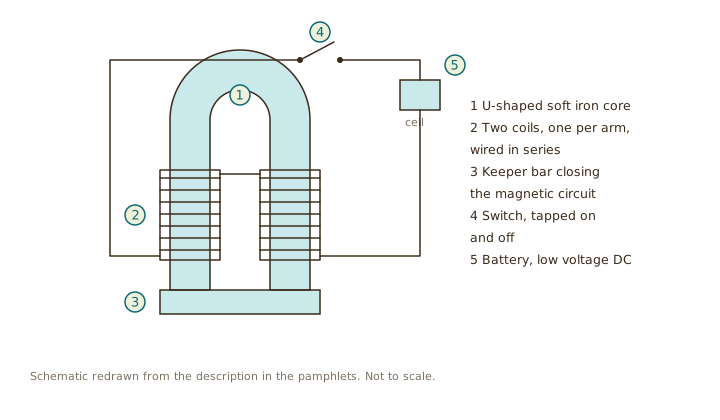
Because the PMH is Leedskalnin's evidence that magnets, once set running in a closed iron loop, keep going on their own. "The drawing on the front cover is like the perpetual motion holder I made," he writes in the 1945 pamphlet. Battery current goes through two coils on an iron bar while a cross bar lies across the prongs. The magnets then "will run around until the cross bar is pulled off."
What he asks you to observe: connect two four-inch (10 cm) soft-steel welding rods to a car battery. Touch the free ends until they heat. Test each end with a small hanging magnet. He predicts the positive-terminal rod acts as a north pole, the negative one as a south pole. Then lift the center of the cross bar to a vertically hanging magnet: the holder, he says, swings it toward the matching pole.
What standard physics says. A PMH is a closed magnetic circuit. Iron is ferromagnetic: unpaired electron spins line up in domains, and part of the magnetization remains after the driving field is removed. That property is remanence (HyperPhysics, Ferromagnetism). The cross bar closes the path, as a keeper does on a horseshoe magnet; nothing circulates. The field of a current forms concentric circles around the wire (HyperPhysics). A battery terminal is defined by chemistry, oxidation at the negative and reduction at the positive (HyperPhysics, Electrochemical cells), not by a magnetic pole. Build, parts and measurement: our PMH guide.
What does Leedskalnin say about mineral life?
Mineral life, in his vocabulary, is whatever holds mineral matter together, and that is magnets. "Mineral life is to hold the mineral matter together," the pamphlet opens. "The base of life is the North and South pole magnets." His example is the zinc in a battery: acid dissolves it, and the magnets that held it leave through the wires.
What he asks you to observe: build a cell with a copper positive terminal and a piece of beef, then one with a sweet potato. He reports more output from the beef and states that iron holds more magnets than wood.
What standard physics says. A zinc cell works by oxidation, Zn(s) → Zn²⁺(aq) + 2e⁻; the electrons flow through the external circuit (HyperPhysics, Electrochemical cells). Chemical bonds hold matter together. Materials do differ magnetically, by electron configuration. "All materials are inherently diamagnetic," some are paramagnetic, and iron, nickel and cobalt are ferromagnetic (HyperPhysics, Magnetic properties of solids). Basics on our magnetism page.
What does he say about vegetable life?
Plants grow, he says, from water, sunlight and magnets; chlorophyll plays no part. "It is not the green chlorophyll that converts the sunlight in plant food, it is the water that does it," he writes in 1945. His evidence is sixteen years of lily pools: clear water in sunlight grows moss within two months. Lightning, he adds, hits the biggest tree because more magnets pass through it.
What he asks you to observe: fill a pool with clear water in sunlight and wait two months.
What standard biology says. Photosynthesis takes place in chloroplasts, where light excites an electron in chlorophyll and the process ends in glucose (HyperPhysics, Photosynthesis). A pool open to the air is not a controlled test; spores arrive with wind, rain and the water itself. On lightning: "Height, pointy shape, and isolation are the dominant factors controlling where a lightning bolt will strike" (NWS). A magnetic sense "may exist in plants," but "no mechanism has been definitely identified" (Wikipedia, Magnetoreception). Nothing in the sources documents magnetism that makes plants grow.
What does he say about animal life?
Muscles move, he says, because magnets contract and release them, and the body gets its magnets from food. "The presence of magnets in our body would indicate that the magnets are operating our muscles," the pamphlet states. "Our digestive system is like a battery but more complicated." His examples: a hand that cannot let go of a power line, flashes from a pushed eye, a meter reading between tongue and feet.
What he asks you to observe: the meter reading between tongue and feet.
What standard biology says. Nerve and muscle cells hold a resting potential of about −70 mV. The action potential comes from Na⁺ and K⁺ ions crossing the membrane (HyperPhysics, Action potentials). A meter reads those potentials; the reading does not separate his theory from electrochemistry. A magnetic sense does exist in animals. "Magnetoreception is a sense which allows an organism to detect the Earth's magnetic field" (Wikipedia, Magnetoreception). It is documented in migratory birds, sea turtles, salmon, sharks, insects and bacteria. Cryptochrome in the bird eye has experimental support; magnetite receptors in vertebrates have not been independently replicated. For humans there is no consensus. That is a sense that detects a field, not magnets driving muscles.
"Life is magnets in motion": what the pamphlet concludes
For Leedskalnin, life is not a property of matter but of the magnets passing through it. "You can destroy the body, but you cannot destroy the magnets that held together the body," he writes in 1945. "Those surplus magnets, they are real life." A living thing gains new capacities when magnets are added, as the PMH gains the ability to swing a hanging magnet.
What standard physics says. Electron spin and orbital motion account for magnetism in matter (HyperPhysics). No magnetic component of life, distinct from chemistry, has been identified. Wikipedia characterizes his writings as contradicting the standard model of electromagnetism (Wikipedia). We report his theory as his theory.
Parts list for the PMH test
| Component | Generic characteristic | What it is for |
|---|---|---|
| U-shaped iron bar, two prongs | soft iron | the closed magnetic path |
| Two coils | enameled magnet wire, one per prong | magnetize the iron |
| Cross bar (keeper) | laminated iron, bridging both prongs | closes the loop; lifted to the hanging magnet |
| Battery | car battery in the text | drives the current |
| Two soft-steel welding rods, clips, leads | four inches (10 cm) each | polarity test at the terminals |
| Two small magnets on threads | one horizontal, one vertical | polarity test and swing test |
No prices, no suppliers; wire gauge, dimensions and what to measure: PMH guide.
Reprint editions
Modern reprints bind this short text with Magnetic Current; a Google Books record lists a volume titled Magnetic Current: Including Mineral, Vegetable and Animal Life.
Where to find it: reprint editions of the pamphlet are sold by major booksellers; the scanned original is free on archive.org.
FAQ
Is Mineral, Vegetable and Animal Life available on archive.org?
Yes. The item 400372815-mineral-vegetable-and-animal-life-pdf, uploaded on January 27, 2021, contains a PDF scan and an OCR text. The OCR has errors, including the copyright year and the author's name, so read the PDF where a detail matters.
When was the pamphlet published? The copyright line reads October 1945 in the transcriptions we hold, and a rare-book dealer dates a physical copy to 1945, Miami, The Franklin Press. The archive.org OCR reads 1946 but is unreliable there. Wikipedia does not date this title.
What is the Perpetual Motion Holder in this pamphlet? An iron bar with two prongs, a coil on each, and a laminated cross bar across the ends. Leedskalnin writes that magnets from a battery keep running around the closed loop until the cross bar is removed. In standard terms it is a closed magnetic circuit that keeps its remanent magnetization.
Do animals sense magnetic fields? Yes, in many species, from migratory birds and sea turtles to magnetotactic bacteria. Cryptochrome in the bird eye has experimental support as a mechanism. For humans there is no consensus. This is a sense that detects the Earth's field, not what Leedskalnin describes.
Sources
- Leedskalnin, E., Mineral, Vegetable and Animal Life, Rock Gate, Homestead, Florida, copyright line October 1945. Scan and OCR: https://archive.org/details/400372815-mineral-vegetable-and-animal-life-pdf
- Leedskalnin, E., Magnetism (advertisement reprinted from the Miami Daily News; text refers to February 3, 1946). Our guide: /coral-castle/magnetism/
- Ellipsis Rare Books, listing of a physical copy (Miami, The Franklin Press, 1945, folded pamphlet, [3] pp.): https://www.ellipsisrarebooks.com/product/mineral-vegetable-and-animal-life-edward-leedskalnin-1945/
- Wikipedia, "Edward Leedskalnin" (five pamphlets; dates of birth and death; characterization of his writings): https://en.wikipedia.org/wiki/Edward_Leedskalnin
- Wikipedia, "Magnetoreception": https://en.wikipedia.org/wiki/Magnetoreception
- HyperPhysics (Georgia State University), "Magnetic properties of solids": https://hyperphysics.gsu.edu/hbase/solids/magpr.html
- HyperPhysics, "Ferromagnetism": https://hyperphysics.gsu.edu/hbase/solids/ferro.html
- HyperPhysics, "Magnetic field of current": https://hyperphysics.gsu.edu/hbase/magnetic/magcur.html
- HyperPhysics, "Electrochemical cells": https://hyperphysics.gsu.edu/hbase/Chemical/electrochem.html
- HyperPhysics, "Action potentials": https://hyperphysics.gsu.edu/hbase/Biology/actpot.html
- HyperPhysics, "Photosynthesis": https://hyperphysics.gsu.edu/hbase/Biology/photosyn.html
- National Weather Service, "Lightning myths and facts": https://www.weather.gov/safety/lightning-myths
Read next: Perpetual Motion Holder: build and physics · Magnetic Base · All guides in reading order