Perpetual Motion Holder: how to build one and what it actually does
The Perpetual Motion Holder (PMH) is a U-shaped soft-iron core with a coil on each leg. An iron bar, the keeper, lies across the open ends. A short pulse of battery current through the coils magnetizes the core; the keeper then stays in place after the battery is removed. The device stores no usable power and produces none. Edward Leedskalnin, builder of Coral Castle, named it in his 1945 pamphlets.
On this page: The "Magnetism" pamphlet · How it is made · Parts list · Build steps · What you observe · What standard physics says · Safety · FAQ · Sources
What does the "Magnetism" pamphlet say?
The text known online as "Magnetism" is Leedskalnin's newspaper advertisement, headed "Reprinted from Miami Daily News, Miami, Florida," followed by several pages of argument.
The advertisement sells Magnetic Current: "Send a dollar by return mail and you will get an eight thousand word booklet, postpaid, and in addition you will get a folder describing what is mineral, vegetable and animal life, and a drawing of a perpetual motion holder." He adds that "the reading is not intended for the general public."
The reprint carries no print date. A later section refers to "my advertisement in The Miami Daily News, February 3rd, 1946," which dates the advertisement. We treat the reprint itself as undated.
His claims, in his terms, run as follows. Electricity is two streams of "north and south pole individual magnets" running against each other. Meters show only half of it. Electrons do not exist. Atoms are these magnets orbiting a core, as he says they orbit in his holder. Of the device he writes that when he breaks its orbit, "I get a flash of light from it."
We present all of this as his theory. The reading guides to Magnetic Current and Mineral, Vegetable and Animal Life go through the arguments section by section.
How is the Perpetual Motion Holder made?
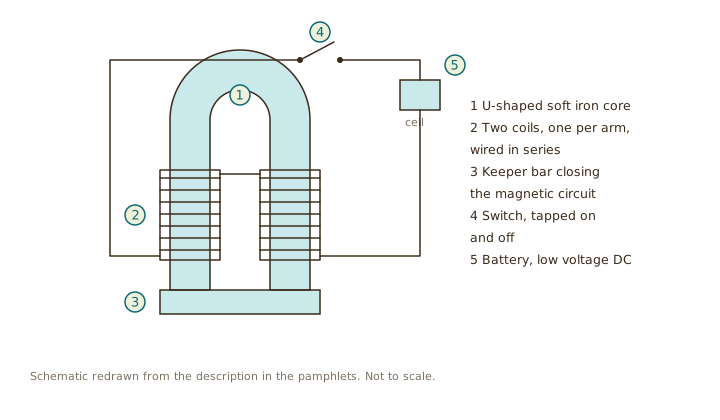
The PMH is a two-coil electromagnet with a removable keeper. Everything in Figure 1 comes from one paragraph of Magnetic Current (1945), which introduces an apparatus "that can be used for four purposes. Electric magnet, transformer, generator and holder of perpetual motion."
① Core. A bar of iron or soft steel, 1.5 in (38 mm) in diameter, bent into a U. Each leg is a foot (30 cm) long; the legs sit 3 in (7.6 cm) apart. Soft iron, not hardened steel, on purpose.
② ③ Coils. Two spools of brass or aluminum, 6 in (15 cm) long, slide over the legs down to the bend. Each carries 1,500 turns of insulated copper wire, size sixteen, connected so that one leg becomes north and the other south.
④ Keeper. A bar of the same iron, 6 in (15 cm) long, laid flat across the two pole ends. In Mineral, Vegetable and Animal Life (1945) he calls it "the laminated iron cross bar." With the keeper on, the magnetic path is a closed loop of iron.
⑤ Battery and switch. He used a car battery and tapped the terminal by hand. Any low-voltage DC source with a switch does the same job.
Parts list
| Component | Generic characteristic | What it does | Source |
|---|---|---|---|
| U-shaped core | Soft iron or low-carbon steel bar, bent (Leedskalnin: 1.5 in diameter, 12 in legs, 3 in gap), or a large steel U-bolt | Low-reluctance flux path; magnetizes and demagnetizes easily | Magnetic Current 1945; vestrilabs 2011 |
| Two coils | Enameled magnet wire on two bobbins. Leedskalnin: 1,500 turns of size 16 wire each; vestrilabs 2011: 22 AWG | Current pulse in, magnetomotive force out; on release, flux change in, voltage pulse out | Magnetic Current 1945; vestrilabs 2011 |
| Keeper bar | Same iron as the core, long enough to bridge both poles (Leedskalnin: 6 in) | Closes the magnetic circuit | Magnetic Current 1945 |
| Switch | Momentary push button or single-pole toggle | Keeps the current pulse short | vestrilabs 2011 |
| Low-voltage DC source | Battery; vestrilabs lists 1 to 12 V DC. Leedskalnin used a car battery | Supplies the magnetizing pulse | both |
| Small lamp (optional) | Low-voltage incandescent bulb; Leedskalnin: "six to eight-volt light bulbs" | Shows the induced pulse when the keeper is pulled | Magnetic Current 1945 |
No prices and no suppliers, by design. The vestrilabs list, the most cited on the web, is unfinished: its core dimensions read "will get the size specs soon."
Build steps
The sequence follows Magnetic Current (1945) and the 2011 vestrilabs write-up. We have not built one; where a step names an outcome, the source is stated.
- Prepare the core. Bend the bar into a U, or mount a U-bolt through a non-magnetic board. Pole faces flat and level, so the keeper touches both.
- Wind the two coils. Same direction, same number of turns on each bobbin. Leave two free ends per coil and mark the start.
- Connect the coils in series. Join the finish of coil ② to the start of coil ③ so current circulates around the U in one direction. Leedskalnin's check: "one end of the bar is North Pole and the other South Pole." If both legs test the same, reverse one coil.
- Fit the keeper. Flat across the poles; any air gap under it weakens the hold.
- Wire battery and switch. Positive to one free coil end through the switch, negative to the other. The switch stays open except during the pulse.
- Pulse the current. Close the switch briefly, then open it. Leedskalnin connects "for a little while," then disconnects.
- Test the hold. Lift the keeper. Builders report that it stays in place with no current flowing. Leedskalnin: "Now the electric magnet holds perpetual motion. If not disturbed it will last indefinitely."
- Release, to see the pulse. Put a low-voltage bulb across the coil ends in place of the battery. Pull the keeper off quickly; the 1945 text says "you will see light in the bulb."
To reset, refit the keeper and repeat step 6.
What do you observe, and how is it "discharged"?
Leedskalnin and later builders report two things. The keeper stays attached after the current stops, and pulling it off gives a brief electrical pulse in the coils. The core is soft iron and was not a magnet before the pulse.
The pulse depends on speed. With a bulb across the coils, a fast pull gives a visible flash; a slow pull gives little or nothing. Leedskalnin says the same of his generator: "Put the coil in slowly and take it out slowly, then you will have no light."
No source we found reports a measured voltage at release, so we give no number. An oscilloscope or peak-hold voltmeter across the coils will show one; it depends on turns, core, and pull speed.
Pulling the keeper is the only "discharge." Once the loop is opened, the soft iron mostly loses its magnetization and the device is back where it started.
What standard physics says
The PMH is a closed magnetic circuit in soft iron; every reported behavior follows from three textbook ideas. Our magnetism basics page covers the vocabulary.
Closed magnetic circuit. In a magnetic circuit, high-permeability iron plays the part of wire and air gaps play the part of resistance. Flux is "largely contained in such high permeability materials" (Kirtley, MIT 6.685 notes, 2003). With the keeper on, the U and the bar form an all-iron loop with almost no gap. A modest magnetomotive force then drives a large flux.
Remanence and hysteresis. Ferromagnetic materials do not return to zero when the driving field is removed. HyperPhysics calls this a magnetic "memory": "Once the magnetic domains are reoriented, it takes some energy to turn them back again." Soft iron keeps little magnetization in open air. Inside a closed iron loop there is no demagnetizing field, so what remains is enough to clamp the keeper. Open the loop and the gap returns, the demagnetizing field returns, and most of that remanence collapses.
Induction at release. By Faraday's law the induced emf in a coil equals the negative rate of change of flux times the number of turns. Opening the loop collapses the flux through 1,500 turns in a fraction of a second, so a voltage pulse appears and a bulb can flash. Lenz's law sets its polarity. The pulse is short because the flux change is short; nothing is generated continuously.
Why "perpetual" is the wrong word. No current flows in the coils after the switch opens; they are an open circuit. What persists is a static magnetic state of the iron, the same thing that keeps a refrigerator magnet on the door. The magnetic energy stored in that state came from the battery pulse and is released once, when the keeper is pulled. The only journal-format treatment, Jefferson (2013), states that after disconnection "the current across the coils remains at 6A." A persistent current in a disconnected coil has no basis in circuit theory, so the paper's figures are not measurements.
Safety
The apparatus is low voltage, but three things can go wrong.
- Heat. Two coils across a car battery are close to a short circuit; Leedskalnin's own instructions repeat "hold until the copper wire gets hot." Keep pulses short and never leave the coils connected.
- Battery shorts. Lead-acid and lithium batteries deliver very high currents into a low resistance. Fuse the lead and keep bare wire ends apart.
- Magnets and implants. A charged PMH, like any strong magnet, can affect pacemakers and implanted defibrillators. Keep it well away from anyone with such an implant and follow the device maker's guidance.
FAQ
Does the Perpetual Motion Holder produce electricity?
No. It stores a magnetic state in soft iron after a battery pulse, and it returns a single brief voltage pulse when the keeper is pulled off. Between those two events no current flows and nothing is generated. The electrical input is a short pulse from a battery; the output is a shorter pulse into a bulb.
Who named it, and when?
Edward Leedskalnin, in the pamphlet Magnetic Current (copyright August 1945), where the same U-core apparatus is described as electric magnet, transformer, generator, and "holder of perpetual motion." The device is also the cover drawing of Mineral, Vegetable and Animal Life (October 1945). The abbreviation PMH is later and belongs to the online community.
Why does the keeper stay on with no current?
Because the closed iron loop has almost no air gap, so the iron's remanent magnetization is not fighting its own demagnetizing field. Open the loop and the gap returns, the demagnetizing field returns, and most of the hold vanishes. HyperPhysics describes this retained state as the material's magnetic "memory."
How long will it hold?
Leedskalnin wrote that he left one closed for six months and got the same light on release. Standard physics has no reason to expect decay in an undisturbed closed soft-iron loop at room temperature, but we know of no independent long-duration measurement, so we report his claim as his claim.
Can I use a horseshoe magnet instead of soft iron?
You can, but it will not be a PMH. A hard-steel or Alnico horseshoe stays magnetized whether or not the keeper is on; the point of Leedskalnin's device is that soft iron does not, except when the circuit is closed. Use a soft-iron U or a low-carbon steel U-bolt, and you will see the difference on opening.
PMH bench parts
A soft-iron U or a large steel U-bolt, two spools of enameled magnet wire, a push-button switch, a low-voltage battery, and a matching iron bar for the keeper. A small low-voltage bulb makes the release pulse visible.
Where to find it: any hardware or electronics supplier; reprint editions of the pamphlet are sold by major booksellers.
Sources
- Leedskalnin, E. Magnetic Current. Rock Gate, Homestead, Florida, copyright August 1945. Scanned edition: https://archive.org/details/ed-leedskalnin-magnetic-current-1945
- Leedskalnin, E. Mineral, Vegetable and Animal Life. Rock Gate, copyright October 1945. Text in the Writings section of leedskalnin.com.
- Leedskalnin, E. Advertisement, Reprinted from Miami Daily News. Undated reprint; refers to the advertisement of February 3, 1946: https://www.leedskalnin.com/Leedskalnins-Writings-ADVERTISEMENT.html
- HyperPhysics (Georgia State University). Hysteresis: http://hyperphysics.gsu.edu/hbase/solids/hyst.html
- HyperPhysics. Magnetically Soft Materials: http://hyperphysics.gsu.edu/hbase/Solids/magsoft.html
- HyperPhysics. Ferromagnetism: http://hyperphysics.gsu.edu/hbase/solids/ferro.html
- HyperPhysics. Electromagnet: http://hyperphysics.gsu.edu/hbase/magnetic/elemag.html
- HyperPhysics. Faraday's Law: http://hyperphysics.gsu.edu/hbase/electric/farlaw.html
- Kirtley, J. L. 6.685 Electric Machines, Class Notes 2: Magnetic Circuit Basics. MIT, 2003: https://ocw.mit.edu/courses/6-685-electric-machines-fall-2013/aa1c6b0cf5de1f6f8111ab1a4b39e2d3_MIT6_685F13_chapter2.pdf
- Jefferson, A. (2013). "Mathematical Model of Edward Leedskalnin's Perpetual Motion Holder." J Appl Computat Math 3:149. doi:10.4172/2168-9679.1000149: https://www.hilarispublisher.com/open-access/mathematical-model-of-edward-leedskalnins-perpetual-motion-holder-2168-9679.1000149.pdf
- Vestri Labs (May 28, 2011). "The Perpetual Motion Holder": https://vestrilabs.wordpress.com/2011/05/28/the-perpetual-motion-holder-investigating-the-principles-behind-edward-leedskalnins-most-famous-device/ (parts list; guide unfinished)
- U.S. Food and Drug Administration. "Magnets in Cell Phones and Smart Watches May Affect Pacemakers and Other Implanted Medical Devices": https://www.fda.gov/radiation-emitting-products/cell-phones/magnets-cell-phones-and-smart-watches-may-affect-pacemakers-and-other-implanted-medical-devices
- Wikipedia, "Edward Leedskalnin" (dates only): https://en.wikipedia.org/wiki/Edward_Leedskalnin
Read next: Magnetism basics: poles, fields, domains and what a U-magnet does · Magnetic Current (1945): a section-by-section reading guide · all guides in reading order on the start here page.