Magnetic Base: Leedskalnin's appeal to researchers, and what he asked them to test
Magnetic Base is the shortest of the five Leedskalnin texts in our Coral Castle hub: about 1,500 words in three parts. The parts are an advertisement addressed to "Researchers, experimenters and other people," a section titled Magnetic Base, and one titled Sound Base. Its claim: North and South pole "individual magnets" are the base of electricity, matter and life. It asks readers to buy Magnetic Current and repeat his battery observations. It is dated 5-20-46.
Key facts
| Fact | Source |
|---|---|
| Three parts: advertisement, Magnetic Base, Sound Base; signed "EDWARD LEEDSKALNIN. 5-20-46" | The pamphlet text |
| Mailing address in the advertisement: Box Holder, Route 1, Box 196, Homestead, Florida | The pamphlet text |
| Leedskalnin "published five pamphlets on various subjects, advertising them in local newspapers" | Wikipedia |
| Where to read it: archive.org holds an audio reading (uploaded 2017); we found no text scan of Magnetic Base there as of September 2026 | archive.org |
| Author: 1887-1951 | Wikipedia |
Who is it addressed to, and what does it ask?
The pamphlet is addressed to researchers and experimenters, and it asks three things: read Magnetic Current, repeat his battery observations, and come to Homestead.
The first part is a mail-order advertisement. Leedskalnin writes: "Researchers, experimenters and other people read about Magnetic Current, then you will know what electricity is, how it is made, what makes it, and the way it runs in a wire." A dollar bill sent to a box holder on Route 1, Homestead, buys the booklet. It comes with a folder on mineral, vegetable and animal life and a drawing of the perpetual motion holder.
The second request closes the acid section: "The one who will find out exactly how it is done will be a real scientist." The third is an invitation to Rock Gate, Homestead, to see his rock telescope and sundial.
What standard physics says. A current-carrying wire is surrounded by a magnetic field whose lines "form concentric circles around the wire," direction given by the right-hand rule (HyperPhysics). Hans Christian Ørsted found this in 1820: a compass needle near a wire turned perpendicular to it (Wikipedia). The compass-and-wire test is in our Magnetic Current guide.
What does "magnetic base" mean in his text?
In Leedskalnin's vocabulary, "magnetic base" means that North and South pole "individual magnets" are the foundation of electricity, matter, radio waves and muscle movement. In Magnetic Base (dated 5-20-46) he writes: "Radio waves cannot be made without electricity, and electricity cannot be made without the North and South pole individual magnets."
He describes two ways of making electricity. A generator uses "free circulating magnets" around the Earth. A battery uses the "bound magnets" that hold matter together, "especially Zinc": North pole magnets leave the positive terminal, South pole magnets the negative one.
His argument against physics: a zinc atom is said to have thirty protons and thirty electrons. Yet when acid takes the zinc apart "not a single proton or electron shows up," so he calls them "non existing things."
What standard physics says. Zinc has atomic number 30 (HyperPhysics). Nobody expects protons or electrons to appear as loose particles in a battery. The electrons leave through the wire as current; the zinc stays in solution as ions. Poles and fields are on our magnetism basics page.
Test 1: zinc in acid, and what comes out of the battery
The first test is to watch zinc dissolve in acid inside a battery and to note what leaves the two terminals. He describes the process closely. The first bubble forms on the metal, swells, "contracts in the middle and cuts off the new bubble," and later bubbles follow in a line.
In his reading, the bubbles are the carriers: the magnets that held the zinc together "go into the bubbles" and return to the Earth's circulation when they burst. In a battery, the same magnets go into the terminals.
What standard physics says. In a zinc-copper cell the zinc is oxidized: Zn → Zn²⁺ + 2e⁻. The electrons "can be transferred from the zinc to the copper through an electrically conducting path as a useful electric current"; the standard cell potential is 1.1 volts (HyperPhysics). The bubbles on bare zinc are hydrogen: strong acids "can remove the passivating layer and the subsequent reaction with the acid releases hydrogen gas" (Wikipedia). The bubbling is documented chemistry; the magnets inside the bubbles are his interpretation.
Test 2: a muscle across the battery terminals
The second test is physiological: "If you want to know how the magnets contract the muscles, connect each end of a fresh terrapin muscle with each terminal of a battery, then you will see how the muscles are contracted." He extends the claim to every sense: outside magnets meeting inside magnets in the nerves.
What standard physics says. A muscle across a battery does contract, and the observation is old. In 1780 Luigi Galvani found that frog leg muscles "twitched when struck by an electrical spark"; Alessandro Volta argued that the contractions "depended on the metal cable Galvani used to connect the nerves and muscles" (Wikipedia). The muscle responds to electric current; the test cannot tell Leedskalnin's magnets from electrons. Animal tissue is not in our parts list.
Test 3: bubbles from three acids
The third observation uses hydrochloric, sulfuric and nitric acid on "many kinds of matter." Every kind produces bubbles, he reports, and "each kind of bubble smells differently." He proposes that acid atoms have "a smaller orbit and few magnets in it" and peel the magnets off larger atoms one by one.
What standard physics says. The gas depends on the metal and the acid; for zinc in hydrochloric or sulfuric acid it is hydrogen (Wikipedia). Different smells point to different gases and vapors. Acids and their fumes need ventilation and eye protection; this page is not a laboratory procedure.
Sound Base: radio waves and seasons
Sound Base lists what each branch of science lacks in his view. Engineers "do not know what electricity is," and physicists chase "non existing protons and electrons." Physiologists, geologists and astronomers miss the magnets behind muscles, gravitation and seasons.
Two claims are specific. Radio waves "are not waves" but magnets leaving a transformer's secondary coil, half into the air and half into the ground. Seasons happen because the Earth's summer end is a stronger magnet pole than the winter end.
What standard physics says. Radio waves are electromagnetic radiation below 300 GHz, produced by "charged particles undergoing acceleration"; Heinrich Hertz generated them in 1887 (Wikipedia). Their wave equation "arises from Maxwell's equations" (HyperPhysics). Seasons come from axial tilt: "The 23.5° tilt of the Earth's spin axis gives the seasonal variations in the amount of sunlight received at the surface" (HyperPhysics). We report gravitation and earthquakes as his claims; geology is outside this site's scope.
How the pamphlet relates to the others
Magnetic Base is the last dated text and reads as a cover note for the others. Its final line: "The above reading, The Magnetic Current, the Mineral, Vegetable and Animal Life and the advertisement they all go together."
The dates we can source come from the archive.org records: A Book in Every Home 1936, Magnetic Current 1945, Mineral, Vegetable and Animal Life October 1, 1945. Our guide to that pamphlet is here. Magnetic Base carries "5-20-46" in the text. The newspaper reprint Magnetism is undated in the sources we checked. Wikipedia counts five pamphlets; Leedskalnin died in December 1951. Our reading order is on the start here page.
Parts list
What the text implies for a bench, with generic characteristics only.
| Component | Generic characteristic | What it is for |
|---|---|---|
| Zinc strip | Plain zinc | The metal that dissolves; anode of the cell |
| Copper strip | Bare copper, same size | Second electrode of a zinc-copper cell |
| Dilute acid | Hydrochloric or sulfuric, in glass | Electrolyte that attacks the zinc |
| Two leads with clips | Insulated copper wire | Connect the cell to a meter or a load |
| Compass | Small magnetic compass | Shows the field around a current-carrying wire |
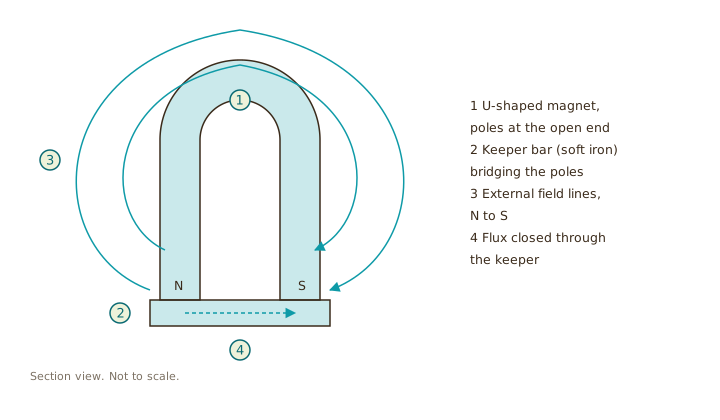
| U-shaped magnet with keeper | Steel or alnico, soft iron keeper | The device in Figure 1, used in Magnetic Current |
Safety: ventilation, gloves and eye protection with acids; never mix acids.
Bench parts for the tests he proposes
A zinc-copper cell in dilute acid reproduces the bubbling and the terminal voltage he describes. A compass beside the wire shows what the advertisement promises to explain; a U-magnet with keeper has the geometry of the perpetual motion holder drawing.
Where to find it: any hardware or electronics supplier; reprint editions of the pamphlet are sold by major booksellers.
FAQ
Is Magnetic Base a separate pamphlet or part of Magnetic Current? It is a separate short text that Leedskalnin says belongs with the others: its closing line groups it with Magnetic Current, Mineral, Vegetable and Animal Life and the advertisement. The transcription we read presents Magnetic Base and Sound Base as one document with the advertisement.
When was Magnetic Base written? The text ends with "EDWARD LEEDSKALNIN. 5-20-46," which we read as May 20, 1946. We found no other date in Wikipedia or on archive.org. Magnetic Current is dated 1945 in its archive.org record.
Where can I read Magnetic Base for free? archive.org hosts an audio reading uploaded in 2017. As of September 2026 we found no text scan of Magnetic Base there; reprint editions of Leedskalnin's pamphlets are sold by major booksellers. We do not reproduce the full text here.
Does Magnetic Base describe the compass-and-wire experiment? No. The advertisement promises that Magnetic Current explains "the way it runs in a wire," but the tests in Magnetic Base are zinc in acid, a muscle across a battery, and bubbles from three acids. The wire experiments, with compass and U-magnet, are in Magnetic Current.
Sources
- Edward Leedskalnin, Magnetic Base (advertisement, Magnetic Base, Sound Base), dated 5-20-46 in the text. Audio reading: https://archive.org/details/MagneticBaseEdwardLeedskalnin
- Edward Leedskalnin, Magnetic Current (1945): https://archive.org/details/edleedskalninmagneticcurrent
- Edward Leedskalnin, Mineral, Vegetable and Animal Life (October 1, 1945): https://archive.org/details/mineral-vegetable-animal-life-0002
- Edward Leedskalnin, A Book in Every Home (1936): https://archive.org/details/30377259edleedskalninabookineveryhome
- Wikipedia, Edward Leedskalnin: https://en.wikipedia.org/wiki/Edward_Leedskalnin
- Wikipedia, Oersted's law: https://en.wikipedia.org/wiki/Oersted%27s_law
- Wikipedia, Luigi Galvani: https://en.wikipedia.org/wiki/Luigi_Galvani
- Wikipedia, Zinc: https://en.wikipedia.org/wiki/Zinc
- Wikipedia, Radio wave: https://en.wikipedia.org/wiki/Radio_wave
- HyperPhysics, Magnetic Field of Current: https://hyperphysics.gsu.edu/hbase/magnetic/magcur.html
- HyperPhysics, Electrochemical Cells: https://hyperphysics.gsu.edu/hbase/Chemical/electrochem.html
- HyperPhysics, Zinc: https://hyperphysics.gsu.edu/hbase/pertab/Zn.html
- HyperPhysics, Electromagnetic Waves: https://hyperphysics.gsu.edu/hbase/Waves/emwv.html
- HyperPhysics, The Ecliptic (seasons): https://hyperphysics.gsu.edu/hbase/eclip.html
Read next: Magnetic Current (1945): a section-by-section reading guide · Magnetism basics: poles, fields, domains and what a U-magnet does